Cellular IoT: Built for Long Battery Life
Featured Blogs
Cellular IoT: Built for Long Battery Life
Cellular IoT connects smart devices using networks like NB-IoT and LTE-M with very low power consumption. It is designed for devices that send small amounts of data and need long battery life. Features like PSM and eDRX help devices sleep most of the time to save energy. This makes Cellular IoT ideal for sensors, trackers, smart meters, and remote monitoring applications.
Categories
- All
- IoT Security & Device Commissioning
- Embedded OTA Solutions
- Low-Power Embedded Systems
- Cellular IoT
- IoT Dashboard Solutions
- Machine Vision
- Healthcare IoT
- Smart Mining
- IoT-powered smart parking
- Clean Tech & Sustainability
- Predictive Maintenance
- LoRaWAN Security
- Automotive
- IoT Device Management
- SecureIoT
- SecureByDesign
- IoT Technology / Smart Systems
- Wearable Technology
Cellular IoT: Built for Long Battery Life
Cellular IoT sounds simple: devices using mobile networks (4G, 5G, NB-IoT, LTE-M) with a SIM to connect to the internet.
But calling it just cellular misses the bigger picture.
The growth of Cellular IoT is driven by a simple reality: most IoT devices operate where traditional connectivity struggles.
Today, more than 15 billion devices are connected, and by 2030 that number is expected to exceed 29 billion. Many of these devices operate where normal connectivity fails - underground basements, farms, shipping containers, or moving assets.
- Embed a regular 4G modem on a soil sensor, and the battery drains within days.
- Use Bluetooth, and the range is too limited.
- Use LoRa, and you need to build your own gateway network.
It’s not just a smaller version of cellular - it’s a redesign built for IoT.
Architecture of a Cellular IoT System
A Cellular IoT system connects devices to the cloud through mobile networks while optimizing power and data usage.

- At the device layer, a microcontroller collects sensor data while the cellular modem manages network communication.
- The network layer authenticates the device, handles connectivity, and routes data through the operator’s infrastructure.
- Finally, the cloud layer receives and processes the data using lightweight protocols like MQTT or CoAP.
- Efficient communication between the device and network is what enables long battery life in Cellular IoT systems.
Cellular networks were originally designed for people - video calls, streaming, and high-speed internet. But IoT devices work very differently.
Most only send small amounts of data occasionally and are expected to run on battery power for years.
Traditional Cellular (4G / 5G)
- High throughput (Mbps to Gbps)
- High power consumption (battery lasts hours to days)
- Continuous network connection overhead
Best for: video cameras, vehicle gateways, teleoperated systems
The challenge: Traditional LTE was never meant for devices like water meters sending 100 bytes per day. Even maintaining the network connection can drain the battery quickly.
The LPWAN Revolution (Low-Power Wide-Area Network)
LPWAN technologies are built for long range and low power instead of high speed. Cellular LPWAN solutions like NB-IoT and LTE-M use licensed mobile networks, providing reliable and secure connectivity for IoT devices.

Role of Power Saving Mechanisms (PSM, eDRX, AS-RAI)
Standard cellular modems would quickly drain batteries if they stayed connected and “listening” all the time. To solve this, Cellular IoT introduced three major power-saving mechanisms.
Power Saving Mode (PSM)
- PSM allows the device to enter deep sleep for long periods while staying registered on the network.
- The device wakes up, sends data, and goes back to sleep, reducing power consumption to microamp levels. The network still remembers the device, but it cannot receive data while sleeping.
- This makes PSM ideal for devices like smart meters that only send data occasionally.

- eDRX balances power saving and connectivity by letting the device wake up at fixed intervals to briefly check for incoming messages.
- After listening, it returns to sleep again. It uses more power than PSM but supports downlink communication, making it useful for trackers, wearables, and smart locks.

Real World Use Case Application
- In smart metering, devices are often installed in basements or underground, where signal conditions are poor and physical access is limited.
- Using NB-IoT with PSM, meters can transmit small data packets (like daily consumption) while staying in deep sleep most of the time.
- This enables 10+ year battery life with reliable connectivity, eliminating frequent maintenance and manual readings.
- Logistics tracking devices are attached to moving assets like trucks, containers, or parcels, requiring continuous connectivity across regions.
- LTE-M is ideal here due to its mobility support and ability to handle handovers between cell towers.
- Combined with eDRX, trackers can balance power and responsiveness, enabling real-time location updates and remote commands without draining the battery quickly.
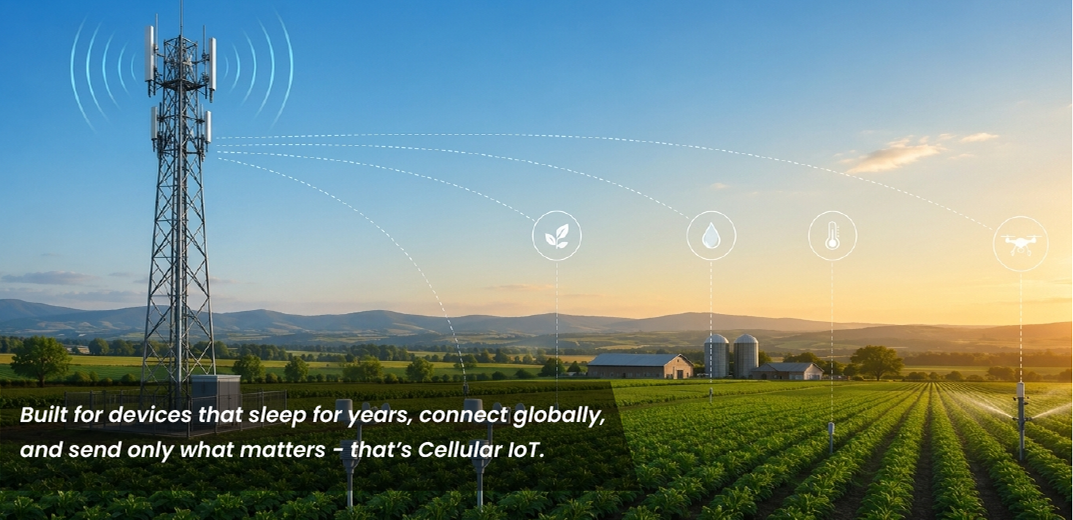
- Agricultural sensors are deployed in remote farms, far from Wi-Fi or power sources. These devices monitor parameters like soil moisture, temperature, and humidity.
- Using NB-IoT with long PSM cycles, sensors can operate for years while sending periodic updates.
- With edge processing, they only transmit critical alerts (e.g., low moisture), reducing data usage and conserving energy.
- Healthcare IoT devices like wearables, heart monitors, and emergency alert systems require reliable connectivity with low power consumption.
- Using LTE-M, these devices can support mobility, real-time alerts, and even voice (VoLTE) for emergency situations.
- With eDRX, the device can stay reachable for critical updates while conserving battery.

Future Trend
5G RedCap (Reduced Capability)
- 5G RedCap is a simplified version of 5G designed for IoT devices needing moderate performance.
- It offers higher data rates than LTE-M with lower complexity and power than full 5G. Ideal for devices like cameras and wearables. It essentially bridges the gap between LTE-M and full 5G.
- Modern IoT devices process data locally instead of sending everything to the cloud.
- Only important events (like faults or alerts) are transmitted over the network. This reduces data usage, lowers power consumption, and enables faster responses.
- It makes devices smarter and more efficient.
- NTN extends cellular IoT connectivity using satellites instead of ground towers. It supports technologies like NB-IoT and LTE-M under 3GPP standards.
- This enables connectivity in remote areas like oceans and deserts.
- It allows truly global IoT deployments without relying on traditional infrastructure.
From smart meters and agricultural sensors to asset trackers and healthcare wearables, Cellular IoT is enabling smarter and more efficient connected systems. With innovations like 5G RedCap and satellite-based NTN connectivity, the future of IoT is becoming more scalable, intelligent, and globally connected.
At Dotcom IoT we believe the real value of Cellular IoT lies in building practical and scalable solutions that can perform reliably in real-world conditions while maintaining long battery life, efficient communication, and seamless cloud connectivity.
“As connectivity moves beyond traditional limits, Cellular IoT is becoming the backbone of scalable and intelligent connected ecosystems.”
Recent Post
Get In Touch With Us
Are You Ready To Grow Your Business With Us?
Drop us a message
- Dotcom IoT : Headquarter

FC 3011, F Tower, Central Wing, Next to ICICI Bank, Bharat Diamond Bourse, G Block, Bandra Kurla Complex, Bandra East, Mumbai 400051, India - Dotcom IoT : R&D Centre
410/4th Floor, Sunshine Commercial Complex, Hans Society, Mota Varachha, Surat, Gujarat 394101. 
USA
20W 47th ST, Suite#1501-A New York, NY 10036-3735.
South Korea
369, Sangdo-Ro, Venture Center, Soongsil Univ., Dongjak-Gu Seoul, South Korea.- +91 85919 00346

- sales@dotcom.co.in

Tag:
#Cellular IoT#Remote Monitoring#LPWANShare:
Milan Pipaliya is an Embedded Firmware Developer focused on ultra-low-power, real-time embedded systems for Industrial IoT and connected devices.