Edge Hardware for Machine Vision: Enabling Autonomous Systems
Featured Blogs
Edge Hardware for Machine Vision: Enabling Autonomous Systems
Efficiency in Artificial Intelligence (AI) utilizing vision systems is the core of any well-designed unmanned system. Whether managing autonomous vehicles (UAVs) or industrial robots, the ability to process data at the "system edge"-physically close to cameras and sensors-represents a fundamental breakthrough for manufacturing and logistics. To maximize the power of AI, systems traditionally required high compute overhead, often handled by centralized GPU clusters. However, the industry is shifting toward edge-native hardware that manages large data streams with minimal power draw and latency.
Categories
- All
- IoT Security & Device Commissioning
- Embedded OTA Solutions
- Low-Power Embedded Systems
- Cellular IoT
- IoT Dashboard Solutions
- Machine Vision
- Healthcare IoT
- Smart Mining
- IoT-powered smart parking
- Clean Tech & Sustainability
- Predictive Maintenance
- LoRaWAN Security
- Automotive
- IoT Device Management
- SecureIoT
- SecureByDesign
- IoT Technology / Smart Systems
- Wearable Technology
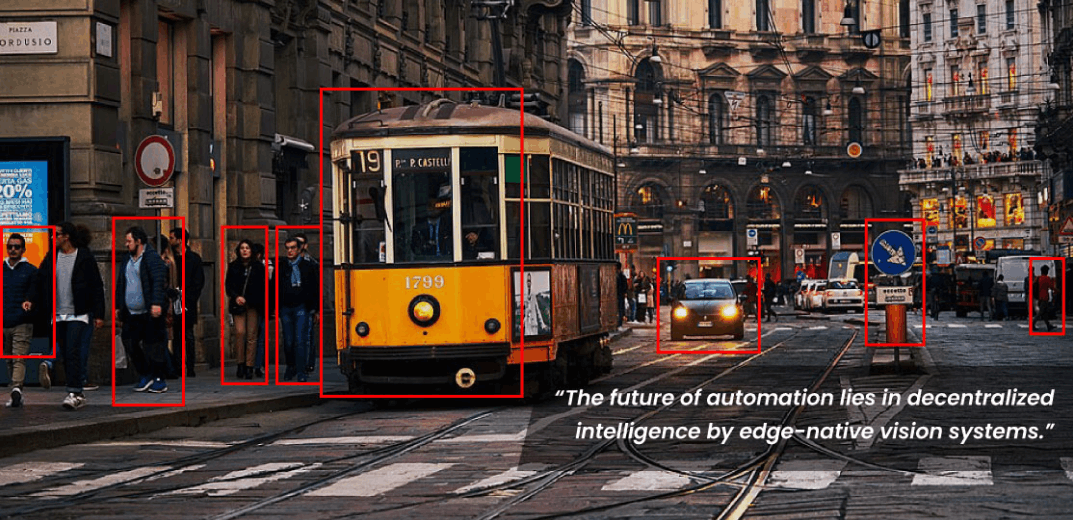
Edge Hardware for Machine Vision: Enabling Autonomous Systems
The Architecture of Autonomy
Edge machine vision integrates high-speed image capture with dedicated hardware acceleration. Unlike traditional systems that rely on external computation, edge systems utilize specialized Silicon designed for parallel processing and low power consumption.
Key Hardware Components:
- Image Signal Processors (ISPs): Integrated into the sensor or the SoC (System on Chip), these handle raw data normalization, noise reduction, and dynamic range adjustments at the hardware level.
- Neural Processing Units (NPUs): Dedicated circuits designed specifically to run deep learning inference (such as YOLO or MobileNet) with high throughput and minimal energy draw.
- Embedded SoCs: Platforms like NVIDIA Jetson, Hailo, and Qualcomm provide a unified environment where the CPU, GPU, and NPU work in concert to manage the vision pipeline and control logic simultaneously.

Technical Advantages of Edge-Based Processing
Moving intelligence to the edge addresses the three primary friction points of modern data-driven systems: latency, bandwidth, and reliability.
Deterministic Low Latency
- Instantaneous Decisions: By closing the "vision-to-action" loop locally, edge systems eliminate the round-trip time to the cloud, enabling millisecond-level reactions.
- Safety-Critical Speed: Local processing ensures that emergency stops or directional corrections in robotics happen at the speed of the hardware bus, not the network.
- Data Reduction at Source: Instead of streaming heavy 4K raw video, edge devices perform local inference and transmit only lightweight metadata like coordinates or labels.
- Network Preservation: This approach reduces infrastructure load by orders of magnitude, preventing network saturation in data-heavy industrial environments.
- Local Autonomy: Edge-native systems maintain 100% functionality during network outages, ensuring production lines and autonomous vehicles remain active and safe.
- Elimination of Single Points of Failure: By removing dependency on external links, the system becomes immune to "dirty" connectivity or signal-dead zones.
Challenges: The Heat and the Light
Edge vision isn`t without its hurdles.
Hardware in the field faces thermal throttling. When a GPU runs at max capacity in a sealed, fanless enclosure under the desert sun, it can overheat, causing the system to slow down just when it`s needed most.
Engineers must balance "Performance per Watt" to keep the silicon cool.
Furthermore, Environmental Variance is the enemy of vision. A model trained in a clean laboratory often fails when faced with the steam of a food processing plant or the strobe effect of flickering overhead lights. Building "robust" edge vision requires feeding the local model thousands of "ugly" images - blurry, dark, and obstructed - until it learns to see through the noise.
Performance Optimization Techniques
Deploying vision models on the edge requires more than just good hardware; it’s about model optimization. You cannot fit a massive, power-hungry GPT-style model onto an edge device.
- Quantization: Reducing the precision of model weights (e.g., from FP32 to INT8) to accelerate execution on hardware with dedicated integer math units.
- Pruning: Systematically removing redundant nodes from a neural network to trim the model size without significantly impacting accuracy.
- Distillation: Training a smaller, "Derived" model to mimic the behavior of a larger, "Reference" model, resulting in a lightweight architecture ready for edge deployment.

Use Cases in Modern Industry
Precision Agriculture:
- UAVs and ground bots identify weeds and pests in real-time, triggering localized spraying systems.
- This "reflex-driven" approach reduces chemical waste by 90% and works flawlessly in remote areas with zero connectivity.
- Edge cameras perform on-device behavioral analysis and facial recognition to detect threats instantly. By processing data at the source, these systems ensure 100% data privacy and eliminate the latency of cloud-based alerts.
- Edge-native silicon fuses LiDAR and camera inputs to adjust to dynamic road obstacles in real-time. This ultra-low latency ensures safe, millisecond-level collaboration between the vehicle and its environment, even at high speeds.
- AI-integrated surgical tools provide instant tissue classification and navigation during delicate procedures. Processing locally on the SoC ensures that visual feedback is perfectly synchronized with the surgeon`s movements, removing life-critical delays.
- Smart shelves and checkout-free systems track inventory and customer actions locally. This "Edge-native" setup ensures the store remains fully operational during network outages while reducing bandwidth costs by sending only metadata.

The Future: Toward Physical AI
The convergence of edge computing and machine vision is leading us toward Physical AI.
This represents a shift from machines that simply "observe" to machines that "interact." With the next generation of edge SoCs delivering hundreds of TOPS (Tera Operations Per Second), we are seeing the rise of humanoid robots and complex autonomous systems that can navigate and manipulate the physical world with human-like dexterity.

About Dotcom IoT
At Dotcom IoT, we design and build edge-driven intelligent systems that operate where decisions matter most—on the device itself. Our expertise spans embedded hardware, edge AI integration, and end-to-end system architecture tailored for real-time applications.
By engineering systems that close the “vision-to-action” loop at the edge, we enable applications that are faster, more resilient, and truly autonomous.
“As AI moves closer to the physical world, the edge becomes the center of innovation.”
Recent Post
Get In Touch With Us
Are You Ready To Grow Your Business With Us?
Drop us a message
- Dotcom IoT : Headquarter

FC 3011, F Tower, Central Wing, Next to ICICI Bank, Bharat Diamond Bourse, G Block, Bandra Kurla Complex, Bandra East, Mumbai 400051, India - Dotcom IoT : R&D Centre
410/4th Floor, Sunshine Commercial Complex, Hans Society, Mota Varachha, Surat, Gujarat 394101. 
USA
20W 47th ST, Suite#1501-A New York, NY 10036-3735.
South Korea
369, Sangdo-Ro, Venture Center, Soongsil Univ., Dongjak-Gu Seoul, South Korea.- +91 85919 00346

- sales@dotcom.co.in

Tag:
##EdgeAI##Machine VisionShare:
Saurabh Mishra is an AI/ML Developer specializing in bringing intelligence to the source at Dotcom IoT. His work focuses on creating "reflex-driven" systems that prioritize local processing, ultra-low latency, and absolute data privacy.