Fall Detection Using mmWave Radar Technology: System Design and Implementation
Featured Blogs
Fall Detection Using mmWave Radar Technology: System Design and Implementation
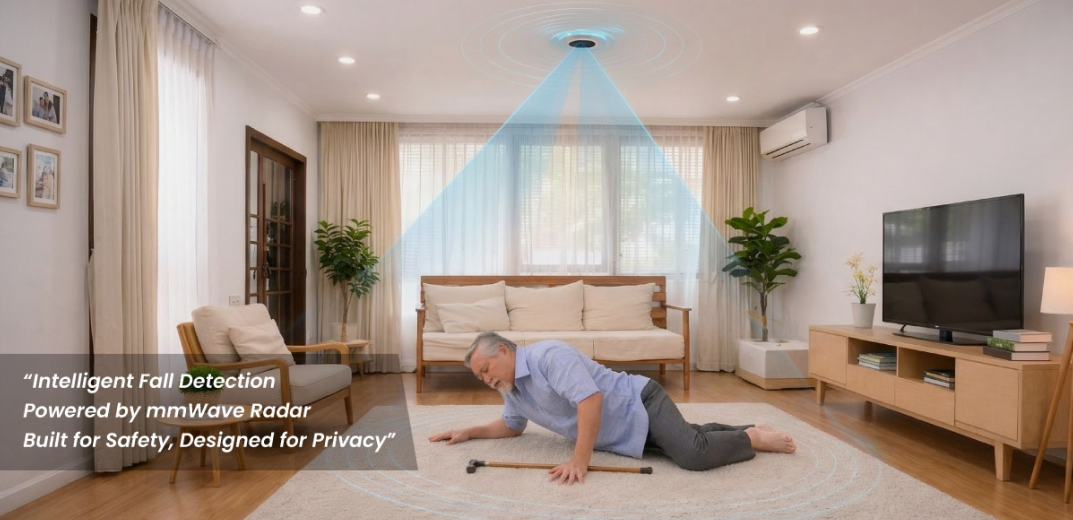
Fall detection sounds straightforward - until you try to implement it in the real world. Most existing solutions force a compromise. Cameras provide visibility but at the cost of privacy, making them unsuitable for personal spaces like bedrooms and bathrooms. Wearables, while effective in theory, rely heavily on user discipline - and in many cases, they are simply not worn when needed most. PIR sensors, on the other hand, depend entirely on motion and fail the moment a person becomes still, which is often exactly what happens after a fall. This creates a clear gap: the need for a system that can detect falls accurately, instantly, and without intruding on personal privacy.
Categories
- All
- IoT Security & Device Commissioning
- Embedded OTA Solutions
- Low-Power Embedded Systems
- Cellular IoT
- IoT Dashboard Solutions
- Machine Vision
- Healthcare IoT
- Smart Mining
- IoT-powered smart parking
- Clean Tech & Sustainability
- Predictive Maintenance
- LoRaWAN Security
- Automotive
- IoT Device Management
- SecureIoT
- SecureByDesign
- IoT Technology / Smart Systems
- Wearable Technology
Fall Detection Using mmWave Radar Technology: System Design and Implementation
Why mmWave Radar Changes the Approach?
mmWave radar offers a fundamentally different way of sensing human presence.
Instead of capturing images, it works by generating a point cloud - a collection of data points that represent movement and position in space. This means the system never “sees” a person in the traditional sense. There are no faces, no identifiable features - just abstract motion data. This makes it inherently privacy-safe.
Beyond privacy, radar also solves environmental challenges. It performs consistently in complete darkness, through steam, and even in visually obstructed conditions where cameras would fail.
One of its most powerful capabilities is detecting micro-movements, such as breathing. This allows the system to recognize the presence of a person even when they are completely still - a critical advantage in fall detection scenarios.
System Overview
Building a reliable fall detection system requires more than just a capable sensor. It depends on how effectively hardware and software work together.
For this implementation, the TI IWR6843AOPEVM was used due to its strong 3D tracking capabilities.
The sensor was mounted at approximately 2 meters in height and angled slightly downward (around 15°) to ensure full coverage - from standing position to the floor.

The device connects to a processing unit such as a PC or an SBC (e.g., Rock 5B+), where real-time data processing and visualization take place.

Turning Raw Data into Meaningful Insights
What makes this system effective is not just the radar itself, but the intelligence behind it.
The sensor runs a specialized tracking firmware that continuously filters out environmental noise - ignoring irrelevant reflections from objects like fans or curtains - and focuses only on patterns that resemble human movement.
Using the Industrial Visualizer GUI, this processed data is displayed as a real-time 3D representation. Instead of a video feed, the system shows a dynamic map of points that reflect a person’s position, movement, and height within the space.

Understanding the Fall Detection Logic
Detecting a fall is not about identifying a person lying on the ground - it’s about understanding how they got there.
The process begins:
Stage 1: Finding and Tracking the Target
The radar scans the environment and isolates relevant signals using filtering techniques, grouping multiple reflection points into a single tracked entity. This ensures that the system consistently follows one individual without confusion.

To focus only on what matters, the software uses Gating and Association:
Gating: The system creates a virtual "boundary" around moving dots. It ignores "ghost" reflections (like a shiny floor) and only pays attention to signals that behave like a human.
Association: Since a person is a "cloud" of dots rather than a single point, the radar groups these reflections together. It recognizes that if 20 dots are moving at the same speed and direction, they belong to one person-assigned as "Target 0."

Stage 2: Continuous Height Estimation
Once "locked on" to a target, the radar identifies the highest points in that cluster to estimate the person’s height.
To prevent the data from "jumping" (for example, if you wave your hand), a smoothing filter is applied to keep the height reading steady as you move throughout the room.
Stage 3: The "Speed of Drop" Test
The core of fall detection lies in analyzing the speed of height change.
A fall isn`t just about being low to the ground; it’s about how fast you got there. The system constantly compares your current height to where you were 2.5 seconds ago.
The 60% Rule: If your height drops by more than 60% within that 2.5-second window, a "Fall Event" is triggered.

This behavior can be clearly observed in the GUI, where the system visualizes the tracked person along with real-time height changes and status updates during a fall event.

Real-Time Visual Alerts
The results of this logic are displayed instantly in the Industrial Visualizer status box:
Green ("Target 0: Safe"): The person is standing, walking, or sitting. Height changes are within normal limits.
Red ("Fall Detected"): A rapid height drop has been detected, triggering an instant alert.
Advantages :

Privacy in Sensitive Spaces
In areas like bathrooms and bedrooms, where privacy is critical, traditional camera-based systems often become unsuitable.
mmWave radar addresses this by detecting human presence and activity without capturing images or identifying individuals. It only processes abstract point-cloud data, ensuring that monitoring remains effective while completely respecting personal privacy.
About the Approach
At Dotcom IoT, we focus on building practical, real-world IoT solutions that solve actual problems - not just concept-level implementations.
This fall detection system is a simple example of how the right combination of sensing technology, embedded processing, and intelligent logic can create reliable safety solutions without compromising privacy.
From hardware design and firmware development to system integration and deployment, the goal is always the same - to build solutions that are accurate, scalable, and ready for real-world use.
As systems like these evolve, integrating alert mechanisms and cloud connectivity will turn detection into a complete monitoring and response ecosystem.
"In safety systems, true value lies not just in detection, but in accurately identifying events at the right moment."
Recent Post
Get In Touch With Us
Are You Ready To Grow Your Business With Us?
Drop us a message
- Dotcom IoT : Headquarter

FC 3011, F Tower, Central Wing, Next to ICICI Bank, Bharat Diamond Bourse, G Block, Bandra Kurla Complex, Bandra East, Mumbai 400051, India - Dotcom IoT : R&D Centre
410/4th Floor, Sunshine Commercial Complex, Hans Society, Mota Varachha, Surat, Gujarat 394101. 
USA
20W 47th ST, Suite#1501-A New York, NY 10036-3735.
South Korea
369, Sangdo-Ro, Venture Center, Soongsil Univ., Dongjak-Gu Seoul, South Korea.- +91 85919 00346

- sales@dotcom.co.in

Tag:
#mmWave Radar#Fall Detection System#Privacy-Safe TechnologyShare:
Mahendra Sondagar is a Chief Technology Officer (CTO) and embedded systems expert specializing in Internet of Things (IoT) product engineering, artificial intelligence, and machine learning.