How Machine Vision is Redefining Industrial Safety for Humans
Featured Blogs
How Machine Vision is Redefining Industrial Safety for Humans
In the modern industrial landscape, the mantra has shifted from "Safety First" to "Safety Always." While traditional safety protocols-like physical barriers, manual audits, and warning signs-have saved countless lives, they share a common vulnerability: they are often reactive and dependent on human vigilance. As we move deeper into the era of Industry, where humans and machines work in closer proximity than ever before, a new sentinel has emerged. Machine Vision (MV) is no longer just a tool for quality control on an assembly line. Today, it serves as an "invisible shield," using advanced optics and artificial intelligence to monitor, predict, and prevent workplace accidents in real-time.
Categories
- All
- IoT Security & Device Commissioning
- Embedded OTA Solutions
- Low-Power Embedded Systems
- Cellular IoT
- IoT Dashboard Solutions
- Machine Vision
- Healthcare IoT
- Smart Mining
- IoT-powered smart parking
- Clean Tech & Sustainability
- Predictive Maintenance
- LoRaWAN Security
- Automotive
- IoT Device Management
- SecureIoT
- SecureByDesign
- IoT Technology / Smart Systems
- Wearable Technology
How Machine Vision is Redefining Industrial Safety for Humans
The Evolution: From Reactive to Proactive Safety
Historically, industrial safety relied on Hardware Interlocks (like light curtains that stop a machine when a beam is broken) and Manual Oversight. While effective, these methods have limitations:
- Blind Spots: Physical sensors can`t "see" context; they only know if a circuit is broken.
- Human Fatigue: Safety officers cannot monitor every corner of a massive plant 24/7.
- Inflexibility: Fixed barriers can hinder productivity and don`t adapt to dynamic environments.
It doesn`t just detect a presence; it understands what is happening. Is that a human walking near a forklift, or just a stray pallet? Is the worker wearing their helmet, or did they leave it in the breakroom? By processing visual data at the speed of light, MV turns safety into a proactive, living system.
Key Applications of Machine Vision in Industrial Safety
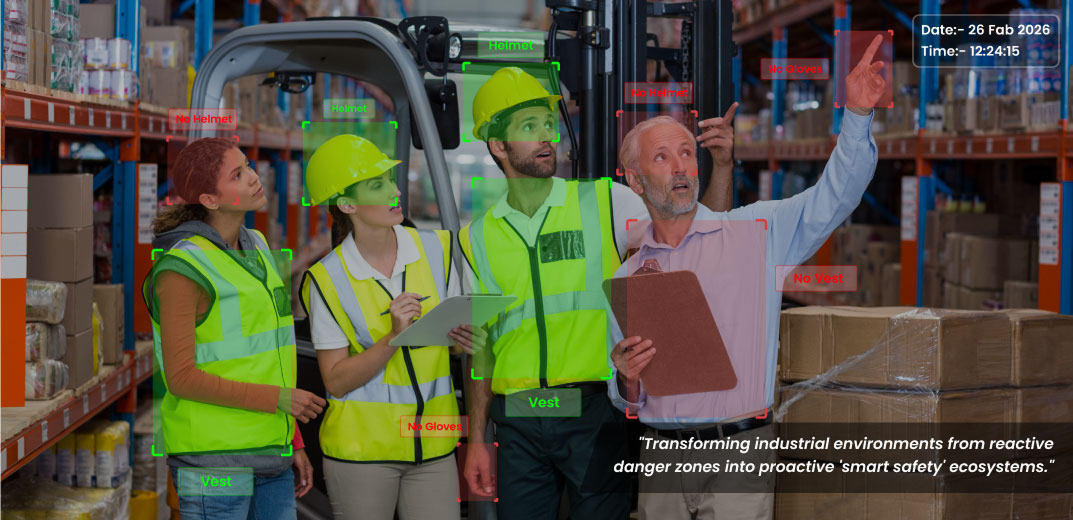
PPE Compliance Monitoring: Personal Protective Equipment (PPE) is the last line of defense. However, compliance is often inconsistent. Machine vision systems can be integrated with existing CCTV networks to automatically detect:
- Hard Hats and Vests: Identifying workers without high-visibility gear in high-traffic zones.
- Specialized Gear: Ensuring respirators, gloves, or safety harnesses are present in chemical or high-elevation areas.
- Automated Access Control: Some plants now use MV-linked turnstiles that won`t open unless the system "sees" the required PPE on the individual.

Dynamic Danger Zones (Virtual Fencing) : Unlike a physical fence, a Virtual Fence is a software-defined boundary.
- Human-Robot Collaboration: In "cobot" environments, MV tracks the distance between a human arm and a robotic limb. If the human gets too close, the robot slows down; if they enter a "red zone," it stops instantly.
- Restricted Areas: The system can trigger a loud alarm or a strobe light the moment an unauthorized person enters a high-voltage or radiation zone.

- Predictive Pathing: MV-equipped vehicles can "see" around corners using mesh-networked cameras, predicting a collision seconds before it happens.
- Blind Spot Alerts: Cameras mounted on heavy machinery can alert operators to pedestrians in their blind spots, specifically identifying "human" shapes to reduce false alarms from static objects.
Ergonomics and Behavior Analysis: Musculoskeletal disorders are among the most common industrial injuries.
- Pose Estimation: Using AI models like YOLO, systems can analyze a worker’s posture during lifting. If a worker consistently uses their back instead of their legs, the system flags this for targeted training, preventing long-term injury.
- Fatigue Detection: By monitoring facial cues and movement speed, MV can identify signs of operator fatigue or heat stress, prompting a mandatory break before a mistake occurs.
The Technical Engine: How It Works
A safety-focused machine vision system is more than just a camera. It consists of four critical layers:
- Imaging Layer: High-resolution (2D, 3D, or thermal) cameras capture real-time visuals, with thermal imaging helping detect overheating or fire risks early.
- Edge Processing Layer: Data is processed locally to minimize latency, enabling instant actions like stopping machines within milliseconds.
- AI Intelligence Layer: AI models analyze the environment to identify risks, understand context, and detect unsafe situations in real time.
- Alert & Integration Layer: The system triggers actions such as alerts, dashboard updates, or machine control signals through PLCs.


Sensifeb – A Multi-Model Sentinel
To understand how these concepts manifest in the real world, we can look at a smart solution “Sensifeb, an AI-powered video detection system” designed & Develop by Dotcom Iot specifically for industrial safety.
Sensifeb represents the "gold standard" of modern safety integration by utilizing a suite of specialized detection models:
- Fall Detection: Instantly identifying when a worker falls to ensure rapid medical response.
- PPE Kit Detection: Real-time verification that helmets, vests, and gloves are being worn in designated zones.
- Fire & Smoke Detection: Identifying thermal hazards and smoke plumes long before traditional ceiling-mounted sensors might trigger.
- Spill Detection: Monitoring floor surfaces for liquid leaks that create slip-and-fall hazards.
- Unauthorized Usage: Detecting mobile phone use in sensitive areas where distraction can lead to catastrophe.
Overcoming the Challenges
Implementing machine vision isn`t without hurdles. Success requires navigating:
- Lighting and Environment: Dust, steam, and flickering lights can confuse basic cameras. Industrial-grade systems use specialized lighting (like IR or polarized) to maintain "visual clarity."
- Privacy: Workers may feel "watched." Leading companies address this by using Anonymization, where the AI identifies "Person A" for safety purposes but blurs faces or converts bodies into "stick figures" (skeletal tracking) so no personal identity is stored.
- Integration with Legacy Systems: Modern MV must talk to 20-year-old machinery. This requires robust API layers and industrial protocols like OPC UA.
The Future: AI-Driven Predictive Safety
We look toward 2026 and beyond As industrial environments become more connected and intelligent, safety systems are also evolving from reactive monitoring to predictive and adaptive protection. Machine vision, combined with AI, will play a key role in shaping this next phase of industrial safety.
Key advancements include:
- Predictive Risk Modeling: Systems will analyze historical and real-time data to identify patterns that indicate potential accidents before they occur.
- Multimodal AI Integration: Combining vision with audio and vibration sensors to detect issues beyond human perception.
- Behavioral Intelligence: Understanding worker movement patterns to flag unsafe habits proactively.
- Adaptive Safety Systems: Dynamic safety zones that adjust automatically based on real-time activity.
- Edge AI Advancements: Faster on-device processing enabling ultra-low latency decision-making without cloud dependency.
About Dotcom IoT
At Dotcom IoT, we specialize in building intelligent, vision-enabled systems that go beyond traditional automation.
From edge-based machine vision solutions to fully integrated IoT platforms, we design systems that can see, analyze, and act in real time-ensuring safer and smarter industrial environments.
By combining hardware, firmware, and AI-driven analytics, we help industries transition from reactive safety models to proactive, intelligent safety ecosystems.
Machine vision is transforming the factory floor from a place of "calculated risk" into a "smart safety zone."
By augmenting human oversight with tireless, 360-degree digital eyes, industries are not just reducing their LTI (Lost Time Injury) rates-they are fostering a culture of care.
In the end, the true value of technology lies in protecting what matters most- human life.
“Machine vision is turning industrial spaces into intelligent safety environments - where risks are not just managed, but anticipated, controlled, and prevented before they impact human life. “
Recent Post
Get In Touch With Us
Are You Ready To Grow Your Business With Us?
Drop us a message
- Dotcom IoT : Headquarter

FC 3011, F Tower, Central Wing, Next to ICICI Bank, Bharat Diamond Bourse, G Block, Bandra Kurla Complex, Bandra East, Mumbai 400051, India - Dotcom IoT : R&D Centre
410/4th Floor, Sunshine Commercial Complex, Hans Society, Mota Varachha, Surat, Gujarat 394101. 
USA
20W 47th ST, Suite#1501-A New York, NY 10036-3735.
South Korea
369, Sangdo-Ro, Venture Center, Soongsil Univ., Dongjak-Gu Seoul, South Korea.- +91 85919 00346

- sales@dotcom.co.in

Tag:
#Edge ComputingShare:
Saurabh Mishra is an AI/ML Developer specializing in bringing intelligence to the source at Dotcom IoT. His work focuses on creating "reflex-driven" systems that prioritize local processing, ultra-low latency, and absolute data privacy.