IoT Device Commissioning: Secure Device Onboarding
Featured Blogs
IoT Device Commissioning: Secure Device Onboarding
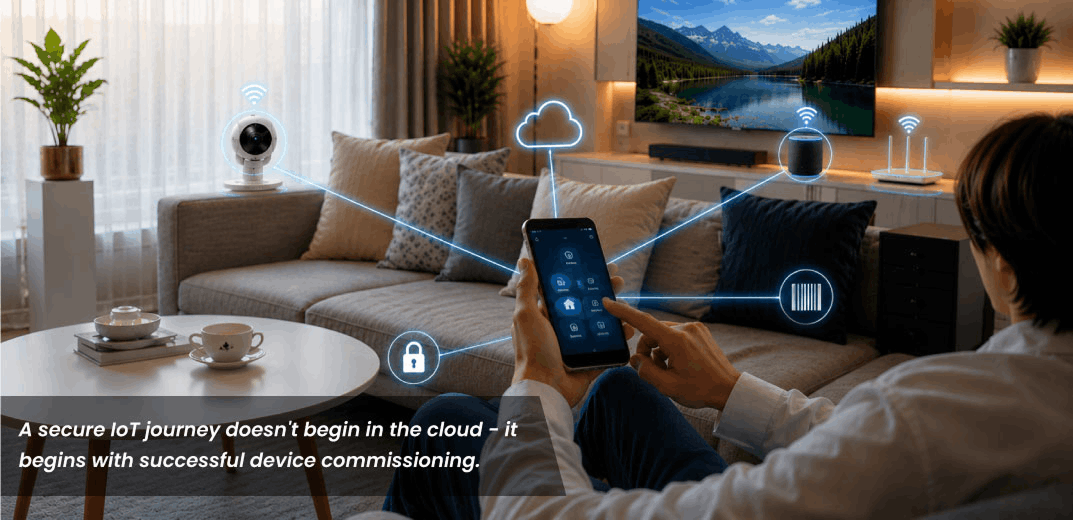
Every IoT device, whether it is installed in a smart home, a hospital, or an industrial facility, needs to go through a setup process before it can start communicating and performing its intended functions. This process is known as device commissioning. IoT device commissioning involves securely configuring, authenticating, and connecting a device to the network and cloud platform, ensuring it is ready for reliable and secure operation.
Categories
- All
- IoT Security & Device Commissioning
- Embedded OTA Solutions
- Low-Power Embedded Systems
- Cellular IoT
- IoT Dashboard Solutions
- Machine Vision
- Healthcare IoT
- Smart Mining
- IoT-powered smart parking
- Clean Tech & Sustainability
- Predictive Maintenance
- LoRaWAN Security
- Automotive
- IoT Device Management
- SecureIoT
- SecureByDesign
- IoT Technology / Smart Systems
- Wearable Technology
IoT Device Commissioning: Secure Device Onboarding
What is IoT Device Commissioning?
IoT device commissioning is the process of setting up a new device and preparing it for secure operation within an IoT system.
It takes a device from its initial, unconfigured state and connects it to the network, cloud platform, and other required services.

- Establishing network connectivity
- Registering the device with the cloud platform
- Verifying device identity and authentication
- Configuring security credentials
- Enabling secure communication
What is IoT Device Commissioning?
IoT device commissioning is the process of setting up a new device and preparing it for secure operation within an IoT system.
It takes a device from its initial, unconfigured state and connects it to the network, cloud platform, and other required services.
The process typically includes:
- Establishing network connectivity
- Registering the device with the cloud platform
- Verifying device identity and authentication
- Configuring security credentials
- Enabling secure communication
Why Device Commissioning Matters?
As IoT deployments grow in size and complexity, device commissioning becomes essential for ensuring secure, reliable, and scalable operations.
A structured commissioning process helps organizations onboard devices efficiently while maintaining security and operational consistency.

How the Commission Handshake Works in iot device?
Device Registration Initialization
When the device powers on, it initializes hardware components and activates communication interfaces such as Wi-Fi, BLE (Bluetooth Low Energy), Ethernet, or Cellular to establish connectivity.

The mobile application discovers the device using onboarding methods such as
- QR code scanning
- BLE discovery
- SoftAP setup
- Local network detection
Once discovered, the device begins the registration initialization process by securely sending initial metadata to the cloud provisioning service.
The backend validates the received information and generates a unique node identity, allowing the device to proceed with secure authentication, certificate provisioning, and cloud onboarding.
Secure Cloud Provisioning

Once the device is discovered and registered, the commissioning process enters the secure authentication and provisioning phase.
During this stage, the device generates its cryptographic identity, exchanges authentication data with the cloud provisioning service, and receives a signed certificate for secure communication.
The workflow includes:
1. Secure Key Generation
- The device generates a unique private key internally, creating the foundation for secure communication and authentication.
- The commissioning application starts the claiming process and requests device onboarding.
- The device shares its identification details with the application, which forwards the information to the cloud platform.
- The cloud registers the device and assigns a unique node identifier for future management and communication.
- Using its private key and assigned identity, the device generates a Certificate Signing Request (CSR).
- The application sends the CSR to the cloud, where the device identity and request are validated.
- After successful verification, the cloud generates and signs a digital certificate for the device.
- The signed certificate is securely delivered back to the device and stored locally.
- With a trusted certificate installed, the device can establish authenticated and encrypted communication with the cloud platform.
User - Node Mapping & Validation
After a device is provisioned, it must be securely linked to the intended user account before remote access and control can be enabled. To achieve this, a Node MApping mechanism is used to verify ownership.
This user-device association is typically performed through a mobile application or CLI during the provisioning process.

- The client sends the user ID and a secret key to the device over BLE.
- The device responds with its unique node ID.
- The client securely shares the node ID and secret key with the cloud platform.
- The device also sends authentication details using secure MQTT communication.
Secure Operational Handoff
Once the signed certificate is installed, and establishes a secure TLS connection with the cloud platform, it can participate in broader smart automation ecosystems
From this point onward, the device can:
- Receive remote commands
- Smart scheduling
- Scene-based automation
- Mobile app synchronization
- Real-time monitoring and analytics
- Perform OTA firmware updates
- Voice-controlled automation
Real-World Use Cases

Future Trends in IoT Commissioning
As IoT ecosystems continue to expand, device commissioning is becoming more intelligent, automated, and security-focused. Modern IoT deployments require faster onboarding, stronger authentication mechanisms, and minimal manual intervention.
Some emerging trends shaping the future of IoT commissioning include:
- Zero-touch provisioning for large-scale deployments
- Device certificate-based trust verification
- Self-healing IoT networks with automated recovery mechanisms
- AI-driven device diagnostics and automated troubleshooting
- Edge-based provisioning for faster local onboarding
- Digital Identity & Certificate Automation
- Matter-enabled commissioning for improved smart device interoperability
The future of IoT commissioning will be driven by automation, cybersecurity, and remote lifecycle management. As connected device deployments continue to grow, efficient and secure commissioning will remain a critical foundation for building scalable and reliable IoT infrastructure.
Building Secure IoT Solutions with Dotcom IoT
At Dotcom IoT, we design and develop end-to-end IoT solutions with a strong focus on secure device connectivity, cloud integration, and lifecycle management.
From hardware and firmware development to cloud platforms and mobile applications, our team helps organizations build scalable IoT ecosystems that are secure, reliable, and deployment-ready.
As IoT deployments continue to grow, implementing robust commissioning workflows becomes essential for ensuring secure onboarding, seamless connectivity, and long-term device management.
“The strength of an IoT ecosystem is determined long before the first data packet is sent - it starts with device commissioning.”
Recent Post
Get In Touch With Us
Are You Ready To Grow Your Business With Us?
Drop us a message
- Dotcom IoT : Headquarter

FC 3011, F Tower, Central Wing, Next to ICICI Bank, Bharat Diamond Bourse, G Block, Bandra Kurla Complex, Bandra East, Mumbai 400051, India - Dotcom IoT : R&D Centre
410/4th Floor, Sunshine Commercial Complex, Hans Society, Mota Varachha, Surat, Gujarat 394101. 
USA
20W 47th ST, Suite#1501-A New York, NY 10036-3735.
South Korea
369, Sangdo-Ro, Venture Center, Soongsil Univ., Dongjak-Gu Seoul, South Korea.- +91 85919 00346

- sales@dotcom.co.in

Tag:
#IoT Device Commissioning#IoT Onboarding Process#Cloud ControlShare:
Nidhi Zalavadiya is an IoT Firmware Developer at Dotcom IoT, specializing in home automation and connected technologies. Her work focuses on device onboarding and creating seamless smart home experiences.