Latest Trends in IoT Web Dashboards in 2026: Transforming Data into Intelligent Decisions
Featured Blogs
Latest Trends in IoT Web Dashboards in 2026: Transforming Data into Intelligent Decisions
Imagine opening an IoT dashboard ten years ago. You would likely see a few graphs, device status indicators, and perhaps a table of sensor readings. At that time, simply accessing real-time data from connected devices felt revolutionary. Businesses were excited to monitor equipment remotely, track environmental conditions, and visualize operational metrics from anywhere in the world. Fast forward to 2026, and the expectations have changed dramatically. Organizations no longer need dashboards that merely display information-they need platforms that can interpret data, predict failures, manage thousands of connected devices, automate workflows, and support critical business decisions. As IoT deployments become larger and more complex, dashboards are evolving into intelligent operational hubs rather than simple monitoring interfaces.
Categories
- All
- IoT Security & Device Commissioning
- Embedded OTA Solutions
- Low-Power Embedded Systems
- Cellular IoT
- IoT Dashboard Solutions
- Machine Vision
- Healthcare IoT
- Smart Mining
- IoT-powered smart parking
- Clean Tech & Sustainability
- Predictive Maintenance
- LoRaWAN Security
- Automotive
- IoT Device Management
- SecureIoT
- SecureByDesign
- IoT Technology / Smart Systems
- Wearable Technology
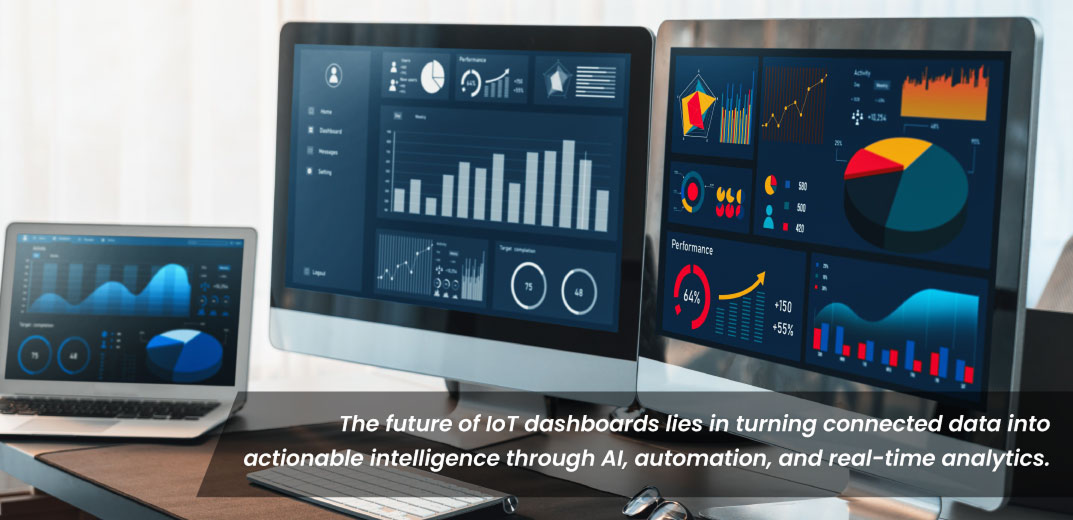
Latest Trends in IoT Web Dashboards in 2026: Transforming Data into Intelligent Decisions
The Evolution of IoT Dashboards
IoT dashboards have evolved from simple monitoring tools into intelligent platforms that provide real-time insights, automation, and data-driven decision-making.
Modern IoT architecture follows:

Traditional Dashboards vs Modern Intelligent Dashboards

The Rise of the Intelligent Dashboard
Another major change occurring in 2026 is the introduction of intelligence directly into dashboard environments.
Historically, dashboards acted as passive interfaces. They displayed information and waited for human interpretation.
Modern platforms are becoming active participants in operational decision-making.
Rather than forcing users to manually investigate anomalies, intelligent dashboards can automatically identify unusual behavior, highlight root causes, and prioritize critical events.
This capability is becoming increasingly valuable as organizations manage larger and more distributed device fleets.
In many cases, the dashboard itself is becoming the first layer of operational analysis.
Latest Trends in IoT Web Dashboards in 2026

AI-Powered Analytics and Predictive Intelligence
- Modern IoT dashboards go beyond displaying sensor data by using AI and Machine Learning (ML) to analyze real-time and historical information. They identify patterns, detect anomalies, predict equipment failures, and recommend corrective actions before issues occur.
- By enabling predictive maintenance, AI-powered dashboards generate automated alerts and maintenance recommendations, helping organizations reduce downtime, extend equipment life, improve operational efficiency, and lower maintenance costs.
Edge Intelligence and Real-Time Analytics
- As IoT deployments grow, processing every sensor reading in the cloud becomes inefficient. Edge intelligence processes data closer to connected devices, enabling real-time analytics with ultra-low latency.
- By filtering and analyzing data locally, organizations reduce bandwidth usage, lower cloud costs, maintain reliable operations during connectivity issues, and achieve faster decision-making through a hybrid edge-cloud architecture.
Automation and Smart Workflows
- Modern IoT dashboards automate operational workflows instead of simply displaying alerts. Based on predefined rules, they can generate maintenance tickets, send notifications, trigger devices, restart equipment, or escalate critical alarms automatically.
- This reduces manual effort, minimizes human error, improves response times, and ensures consistent operations across connected systems.
Digital Twins
- Digital Twins create virtual replicas of physical assets by continuously synchronizing real-time IoT data. They allow operators to monitor asset health, simulate operating conditions, predict failures, and evaluate improvements before implementing changes.
- Combined with AI-driven insights, Digital Twins improve maintenance planning, reduce downtime, and optimize overall operational performance.
Role-Based Personalized Dashboards
- Modern IoT dashboards are becoming increasingly user-centric by offering personalized experiences based on individual roles and responsibilities.
- Rather than presenting identical information to every user, dashboards automatically display the most relevant KPIs, alerts, reports, and visualizations for each role.
Unified Multi-Protocol Device Management
- Today`s IoT ecosystems often include devices that communicate using different protocols and technologies. Modern dashboards are designed to integrate data from multiple communication standards such as MQTT, Modbus, OPC UA, BACnet, LoRaWAN, Zigbee, BLE, Wi-Fi, and cellular networks into a single unified platform.
- By providing centralized visibility across diverse devices and systems, organizations eliminate the need for multiple monitoring applications. Unified device management improves interoperability, simplifies large-scale deployments, enhances operational efficiency, and enables seamless management of complex IoT infrastructures.
Remote Device Management and OTA Updates
- Modern IoT dashboards simplify large-scale device management by enabling remote configuration, diagnostics, and Over-the-Air (OTA) firmware updates from a centralized platform. Administrators can deploy software updates, monitor update status, and resolve issues without physically accessing devices.
- This reduces maintenance efforts, improves security through timely firmware patches, ensures devices remain up to date, and enables organizations to manage distributed IoT deployments more efficiently.
Enhanced Security Monitoring
- Advanced IoT dashboards continuously monitor devices, networks, and user activities to detect cyber threats and unauthorized access.
- AI-powered security analytics generate instant alerts, monitor firmware integrity, enforce access controls, and maintain audit logs, helping organizations strengthen cybersecurity and protect critical infrastructure.
Sustainability and Energy Tracking
- Modern dashboards provide real-time visibility into energy consumption, resource utilization, and environmental performance.
- Advanced analytics help organizations monitor carbon emissions, improve energy efficiency, reduce operational costs, and support ESG reporting through automated monitoring and intelligent reporting.
5G-Powered IoT Ecosystem
- 5G enables IoT dashboards to support massive device connectivity with ultra-low latency and high-speed communication.
- Technologies such as Enhanced Mobile Broadband (eMBB) and Massive Machine-Type Communication (mMTC) improve scalability, reliability, and real-time monitoring for smart factories and large-scale industrial IoT deployments.
Benefits of Modern IoT Web Dashboards
Modern IoT dashboards are transforming the way organizations monitor, analyze, and manage connected systems. By combining AI, automation, edge computing, and real-time analytics, businesses can move beyond simple monitoring and make faster, data-driven decisions.
Key benefits include:
- Faster operational decision-making with real-time insights.
- Reduced equipment downtime through predictive maintenance.
- Improved productivity with automated workflows.
- Better scalability for managing thousands of connected devices.
- Enhanced cybersecurity and centralized device management.
- Optimized energy consumption and sustainability reporting.
- Lower operational costs through intelligent resource utilization.
- Greater visibility across distributed IoT infrastructure.
Real-World Use Cases of Modern IoT Dashboards

- The future of IoT dashboards extends far beyond data visualization. As Artificial Intelligence, Digital Twins, Edge Computing, and 5G continue to mature, dashboards will evolve into intelligent operational platforms capable of analyzing data, predicting outcomes, and initiating automated actions with minimal human intervention.
- In the coming years, organizations will increasingly rely on autonomous dashboards that not only monitor connected assets but also optimize performance, enhance security, improve sustainability, and support strategic business decisions in real time.
- Modern IoT solutions require more than connected devices-they need intelligent dashboards that transform complex data into actionable insights.
From industrial equipment and energy systems to smart buildings and connected healthcare devices, our dashboard solutions are designed to deliver operational visibility, improve decision-making, and support scalable IoT deployments.
"Data is everywhere. Intelligence is the difference. Modern IoT dashboards bridge that gap by transforming real-time information into business value."
Recent Post
Get In Touch With Us
Are You Ready To Grow Your Business With Us?
Drop us a message
- Dotcom IoT : Headquarter

FC 3011, F Tower, Central Wing, Next to ICICI Bank, Bharat Diamond Bourse, G Block, Bandra Kurla Complex, Bandra East, Mumbai 400051, India - Dotcom IoT : R&D Centre
410/4th Floor, Sunshine Commercial Complex, Hans Society, Mota Varachha, Surat, Gujarat 394101. 
USA
20W 47th ST, Suite#1501-A New York, NY 10036-3735.
South Korea
369, Sangdo-Ro, Venture Center, Soongsil Univ., Dongjak-Gu Seoul, South Korea.- +91 85919 00346

- sales@dotcom.co.in

Tag:
#Web Applications#IoT web dashboard#IoT dashboard trendsShare:
Neha Rathod is a Web Developer at Dotcom IoT. Working at the intersection of code and infrastructure, she specializes in building robust APIs, managing cloud platforms, and automating delivery pipelines.