Power Management in Zephyr RTOS for Low-Power IoT Devices
Featured Blogs
Power Management in Zephyr RTOS for Low-Power IoT Devices
The rapid growth of IoT has created a world filled with connected sensors, trackers, smart meters, wearable devices, and industrial monitoring systems. Most of these devices operate on batteries and are often deployed in locations where frequent charging or maintenance is impractical. In such systems, power management is not just an optimization feature - it is one of the most critical design requirements. This is where Zephyr RTOS becomes highly valuable. Zephyr is an open-source real-time operating system designed specifically for resource-constrained embedded devices. It provides flexible and efficient power management features that help developers build ultra-low-power IoT applications without sacrificing performance or connectivity.
Categories
- All
- IoT Security & Device Commissioning
- Embedded OTA Solutions
- Low-Power Embedded Systems
- Cellular IoT
- IoT Dashboard Solutions
- Machine Vision
- Healthcare IoT
- Smart Mining
- IoT-powered smart parking
- Clean Tech & Sustainability
- Predictive Maintenance
- LoRaWAN Security
- Automotive
- IoT Device Management
- SecureIoT
- SecureByDesign
- IoT Technology / Smart Systems
- Wearable Technology
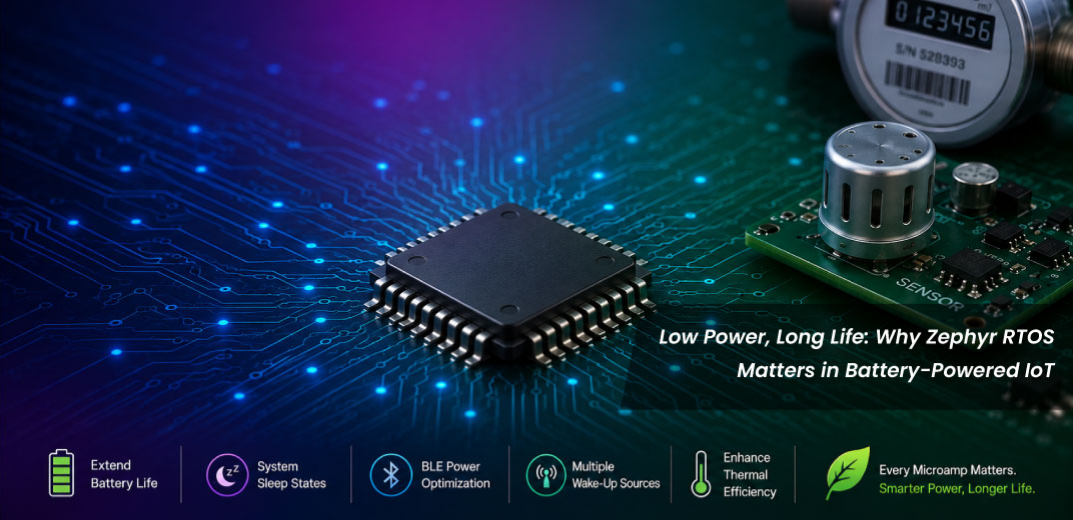
Power Management in Zephyr RTOS for Low-Power IoT Devices
Why Low Power Matters in IoT ?
Unlike smartphones or laptops, many IoT devices are expected to operate for years on a small battery. Applications such as smart water meters, environmental sensors, agricultural monitoring systems, and wearable health devices may only transmit small amounts of data occasionally, but they must remain functional continuously.
Power consumption directly affects:

For example, replacing batteries in thousands of remote IoT nodes can become extremely expensive and operationally difficult. Efficient power management allows devices to remain in sleep mode most of the time while waking up only when necessary.
Overview of Zephyr RTOS Power Management
Zephyr RTOS provides multiple layers of power optimization. Instead of keeping the CPU and peripherals active continuously, Zephyr intelligently controls hardware resources depending on system activity.
Its power management framework mainly includes:
- System Power Management
- Device Runtime Power Management
- Tickless Kernel support
- CPU sleep state handling
- Peripheral suspend and resume mechanisms
The goal is simple: keep every component in the lowest possible power state whenever it is idle.
System Power Management
System Power Management focuses on reducing overall CPU and system-level power consumption. When the scheduler detects that no tasks are ready to run, Zephyr automatically transitions the processor into a low-power state.
Depending on the hardware platform, these states may include:
- Idle Mode - The CPU temporarily stops executing instructions while most peripherals remain operational. Wake-up time is very fast, making it suitable for short idle periods.
- Light Sleep Mode - Certain clocks and internal modules are disabled to reduce power usage while preserving quick system recovery.
- Deep Sleep Mode - Major hardware blocks, high-frequency clocks, and unused peripherals are powered down to achieve ultra-low power consumption.

Device Runtime Power Management
While system-level power management handles the CPU, Device Runtime Power Management focuses on peripherals such as:
- 2C controllers
- SPI buses
- UART interfaces
- Sensors
- BLE radios
For example, an environmental sensor wakes every 10 minutes, collects temperature data, transmits it, and then returns to sleep. Keeping the sensor active between measurements would waste significant energy unnecessarily.
This runtime control is especially important in battery-powered systems where radios and sensors often consume more power than the CPU itself.
Tickless Kernel Concept
Traditional RTOS systems generate periodic timer interrupts known as “ticks.” Even when the system has nothing to process, the CPU wakes repeatedly just to handle these timer events.
Zephyr solves this problem using a tickless kernel.
In a tickless system:
- The kernel suppresses unnecessary periodic interrupts
- The CPU sleeps for longer durations
- Wake-up occurs only when an actual event happens
This significantly reduces idle power consumption and improves battery life in low-duty-cycle IoT devices.
Tickless operation is particularly beneficial for applications that spend most of their time sleeping, such as NB-IoT sensors or BLE beacon devices.
Sleep States & Wake-Up Sources
Sleep states are effective only if the system can wake reliably when needed. Zephyr supports multiple wake-up sources depending on the hardware platform.
Common wake-up events include:
- GPIO interrupts
- RTC timers
- BLE activity
- Sensor thresholds
- UART communication
- Network events
For instance, a motion sensor wakes the MCU only when movement is detected. Similarly, an RTC timer wakes a smart meter once per hour to upload usage data.
Selecting the correct wake-up source is essential because unnecessary wake events can drastically reduce battery life.
BLE Power Optimization
Bluetooth Low Energy (BLE) is widely used in wearable devices, smart locks, asset trackers, and medical sensors. However, wireless communication can easily dominate overall power consumption if not optimized correctly.
Zephyr provides several mechanisms to reduce BLE power usage:
- Increasing connection intervals
- Using extended advertising intervals
- Reducing transmit power
- Entering sleep between BLE events
- Optimizing scanning windows
For example, a fitness tracker does not need continuous real-time communication. By transmitting data periodically instead of constantly, battery life can improve dramatically.
Efficient BLE configuration often determines whether a device lasts days, months, or even years on battery power.
Practical Design Considerations
Power optimization is not achieved through software alone. Developers must consider both hardware and firmware design together.
Important practical considerations include:
- Selecting low-power sensors and MCUs
- Disabling unused peripherals
- Minimizing logging and debugging activity
- Reducing radio transmission frequency
- Optimizing interrupt handling
- Avoiding unnecessary polling loops
Even small inefficiencies repeated continuously can create major battery drain over time.
In real-world IoT systems, developers typically profile current consumption during different operating states to identify hidden power issues.

Future of Ultra-Low Power IoT
The future of IoT is moving toward ultra-low-power and long-life devices powered by technologies like energy harvesting, AI-enabled edge processing, and next-generation wireless connectivity.
Zephyr RTOS continues to evolve with smarter power management and improved low-power capabilities, helping developers build devices that can operate for years while staying continuously connected.
As IoT expands across smart cities, healthcare, industrial automation, and agriculture, efficient power management will remain one of the most important aspects of embedded system design.
The success of low-power IoT devices depends not only on hardware efficiency but also on how intelligently software manages every microamp of energy.
About Dotcom IoT
At Dotcom IoT, we focus on developing efficient and optimized embedded IoT solutions for real-world applications.
From low-power wearable devices and smart monitoring systems to industrial and connected healthcare solutions, we understand the importance of intelligent power management in modern IoT product development.
By combining optimized hardware design, embedded firmware, wireless connectivity, and platforms like Zephyr RTOS, we help build reliable IoT systems designed for long-term, energy-efficient operation.
“Power optimization with Zephyr RTOS is enabling the next generation of efficient and long-lasting IoT devices.”
Recent Post
Get In Touch With Us
Are You Ready To Grow Your Business With Us?
Drop us a message
- Dotcom IoT : Headquarter

FC 3011, F Tower, Central Wing, Next to ICICI Bank, Bharat Diamond Bourse, G Block, Bandra Kurla Complex, Bandra East, Mumbai 400051, India - Dotcom IoT : R&D Centre
410/4th Floor, Sunshine Commercial Complex, Hans Society, Mota Varachha, Surat, Gujarat 394101. 
USA
20W 47th ST, Suite#1501-A New York, NY 10036-3735.
South Korea
369, Sangdo-Ro, Venture Center, Soongsil Univ., Dongjak-Gu Seoul, South Korea.- +91 85919 00346

- sales@dotcom.co.in

Tag:
#Zephyr RTOS#power optimization#Low Power DesignShare:
Milan Pipaliya is an Embedded Firmware Developer focused on ultra-low-power, real-time embedded systems for Industrial IoT and connected devices.