Smart Mining: How IoT, Sensors & AI Are Redefining the Future of Mining
Featured Blogs
Smart Mining: How IoT, Sensors & AI Are Redefining the Future of Mining
Mining has always been one of the most challenging and high-risk industries. Whether deep underground or across vast open-pit sites, miners operate in harsh environments filled with heavy machinery, unstable geology, hazardous gases, and limited visibility. Traditionally, safety and productivity depended heavily on manual inspections, fixed maintenance schedules, and human experience. Today, this is changing rapidly. Mining is entering a new phase — Smart Mining — where IoT, sensor networks, wireless communication, and AI-driven analytics are transforming mines into connected, intelligent ecosystems. What was once reactive and manual is becoming predictive, automated, and data-driven.
Categories
- All
- IoT Security & Device Commissioning
- Embedded OTA Solutions
- Low-Power Embedded Systems
- Cellular IoT
- IoT Dashboard Solutions
- Machine Vision
- Healthcare IoT
- Smart Mining
- IoT-powered smart parking
- Clean Tech & Sustainability
- Predictive Maintenance
- LoRaWAN Security
- Automotive
- IoT Device Management
- SecureIoT
- SecureByDesign
- IoT Technology / Smart Systems
- Wearable Technology
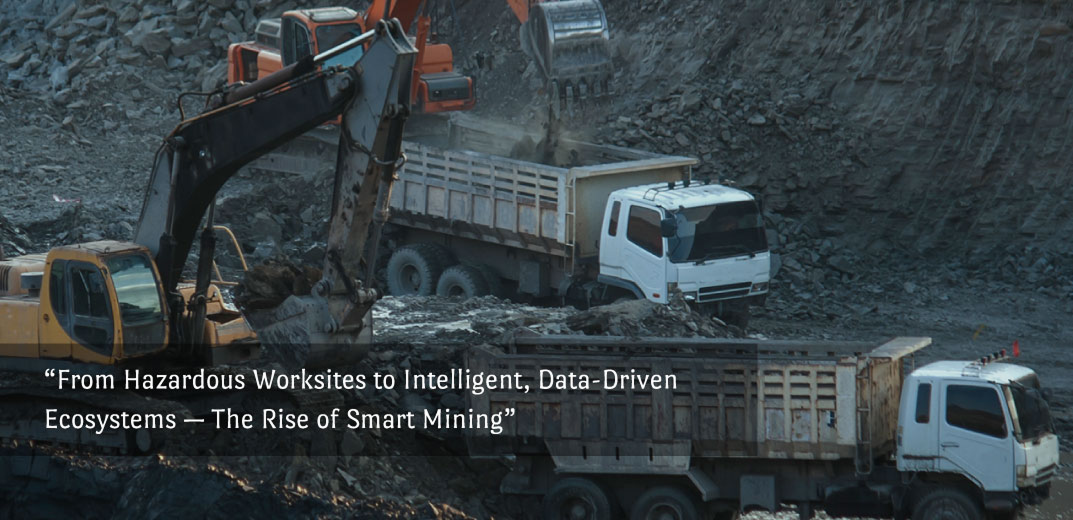
Smart Mining: How IoT, Sensors & AI Are Redefining the Future of Mining
From
Darkness to Awareness: Sensors Bringing Mines to Life
At the core of
smart mining lies a dense network of sensors that continuously convert physical
conditions into real-time digital data.
Inside underground
tunnels, gas sensors monitor methane (CH₄), carbon monoxide (CO), and
other toxic gases, triggering alerts when levels cross safe limits. Temperature
and humidity sensors help assess ventilation effectiveness, while dust
and particulate sensors track air quality to protect workers from long-term
respiratory risks.
Structural safety
is enhanced through pressure, tilt, and strain sensors embedded in rock
walls, pillars, and slopes. These sensors detect micro-movements or stress
changes, providing early warnings of potential collapses or rock falls — long
before visible signs appear.
Mining equipment is
also instrumented. Vibration sensors on crushers, drills, conveyors, and
pumps detect bearing wear, imbalance, or misalignment. Pressure sensors
identify hydraulic leaks, while proximity and position sensors help
prevent collisions in low-visibility zones. Together, these sensors replace
blind operations with continuous situational awareness.

Mining is not only
about machines — it’s about people. Smart mining integrates wearable IoT
devices to protect workers operating in hazardous environments.
Smart helmets,
badges, or vests can track location, motion, fall events, gas exposure, and
vital signs such as heart rate or body temperature. If a worker enters a
dangerous zone, remains immobile after a fall, or is exposed to unsafe gas
levels, the system instantly generates alerts with precise location data.
Supervisors gain
real-time visibility into who is underground, where they are, and whether
conditions are safe. In emergencies, this automated visibility replaces manual
headcounts and speeds up evacuation or rescue — saving critical minutes and,
potentially, lives.

The
Communication Backbone Underground and Above Ground
All this intelligence depends on reliable communication — even where GPS and conventional wireless networks fail.
- BLE Mesh networks are well-suited for underground environments. Wearables, fixed beacons, and repeaters form self-healing networks where data hops node to node, ensuring reliability even if one link fails.
- LoRa / LPWAN technologies cover large surface mines, tracking vehicles, environmental sensors, and assets across kilometers with low power consumption.
- Edge gateways installed at tunnel entrances or control zones aggregate data locally and forward it securely to cloud platforms for analytics and visualization.

Intelligence
on Top: AI and Predictive Maintenance
Sensor data becomes
truly powerful when combined with analytics
and AI.
Instead of fixed
preventive maintenance schedules, predictive maintenance models learn
the normal behavior of equipment using vibration, temperature, pressure, and
load data. When patterns deviate from the baseline, the system flags early
warnings — days or weeks before failure. Maintenance teams can act proactively,
reducing downtime, repair costs, and safety risks.
AI also enables dynamic
risk assessment. By correlating gas levels, structural sensor data,
environmental conditions, and worker locations, systems can identify high-risk
scenarios and trigger evacuations before accidents occur.
For open-pit mines,
analytics optimize fleet management, fuel usage, equipment utilization,
and idle time — improving productivity while lowering environmental impact.
Automation,
Digital Twins, and the Road Ahead
As connectivity and
data quality improve, mining operations are increasingly adopting remote-controlled
and autonomous equipment, reducing human exposure to hazardous zones.
Advanced platforms
now use digital twins — virtual replicas of mines, equipment, and
processes — to simulate blast planning, ventilation strategies, maintenance
schedules, and production scenarios before executing them in the real world.
The shift is clear:
from preventive to predictive and proactive operations.
Why
Smart Mining Truly Matters
Smart mining is not just about efficiency or cost savings:
- Worker safety improves through continuous monitoring and instant alerts.
- Operational resilience increases as failures are predicted, not reacted to.
- Environmental impact is reduced through optimized energy, fuel, and resource usage.
- Scalability becomes easier with wireless, modular architectures.
- Decision-making shifts from intuition to real-time
data and analytics.
Building
Smart Mining Solutions with Dotcom IoT
Backed
by deep experience in IoT hardware, embedded design, sensor networking,
BLE/mesh communication, and cloud integration, Dotcom
IoT enables smart mining solutions from the ground up —
spanning industrial sensors, connected wearables, secure gateways, cloud
dashboards, and AI-driven predictive insights.
Smart mining is no longer a vision of the future. It is already reshaping how mines operate — making them safer, smarter, and more sustainable.
Recent Post
Get In Touch With Us
Are You Ready To Grow Your Business With Us?
Drop us a message
- Dotcom IoT : Headquarter

FC 3011, F Tower, Central Wing, Next to ICICI Bank, Bharat Diamond Bourse, G Block, Bandra Kurla Complex, Bandra East, Mumbai 400051, India - Dotcom IoT : R&D Centre
410/4th Floor, Sunshine Commercial Complex, Hans Society, Mota Varachha, Surat, Gujarat 394101. 
USA
20W 47th ST, Suite#1501-A New York, NY 10036-3735.
South Korea
369, Sangdo-Ro, Venture Center, Soongsil Univ., Dongjak-Gu Seoul, South Korea.- +91 85919 00346

- sales@dotcom.co.in

Tag:
#Predictive Maintenance#SmartMining#MiningTechnologyShare:
Tanvi Kukadiya is a Business Development Executive at Dotcom IoT LLP, specializing in strategic content, B2B outreach, and market research for IoT-based solutions.