Web Dashboards for IoT: Connected Intelligence
Featured Blogs
Web Dashboards for IoT: Connected Intelligence
Behind every successful IoT system is a powerful web dashboard that transforms raw device data into real-time insights, intelligent automation, and centralized control. An IoT dashboard is not just a monitoring screen - it is the operational core of the entire connected ecosystem. A robust IoT dashboard requires a combination of scalable backend systems, real-time communication, modern frontend frameworks, and strong security practices. It serves as the interface where complex device data is transformed into meaningful insights and actionable operation.
Categories
- All
- IoT Security & Device Commissioning
- Embedded OTA Solutions
- Low-Power Embedded Systems
- Cellular IoT
- IoT Dashboard Solutions
- Machine Vision
- Healthcare IoT
- Smart Mining
- IoT-powered smart parking
- Clean Tech & Sustainability
- Predictive Maintenance
- LoRaWAN Security
- Automotive
- IoT Device Management
- SecureIoT
- SecureByDesign
- IoT Technology / Smart Systems
- Wearable Technology
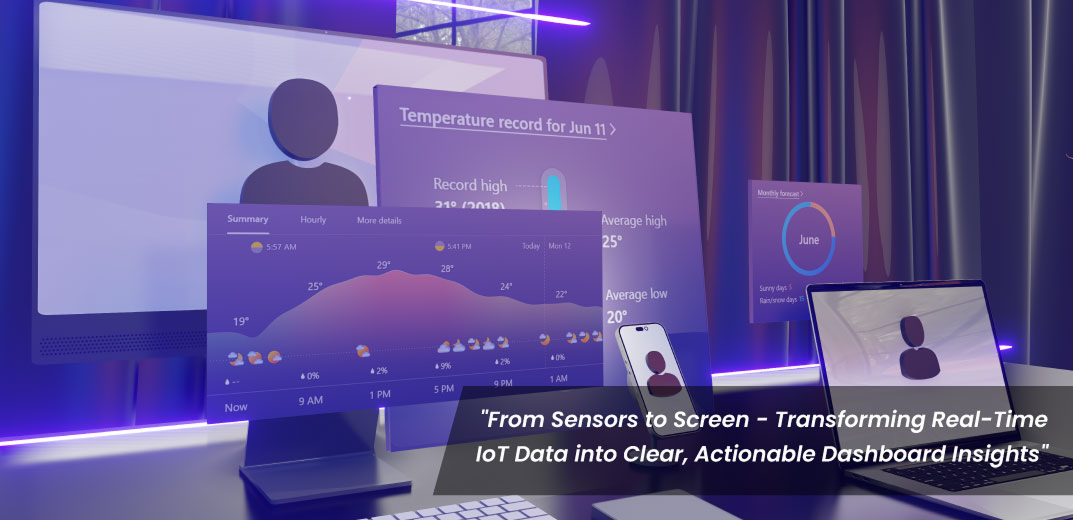
Web Dashboards for IoT: Connected Intelligence
What is a Web Dashboard?
A web dashboard is a browser-based interface that provides real-time visibility into system data through visual components such as charts, tables, and status indicators.
It acts as a bridge between users and connected systems, enabling:
- Real-time monitoring
- Historical data analysis
- Device control and automation
- Alerts and notifications
- Customer Management
IoT Dashboard Working Flow
A modern IoT dashboard follows a seamless real-time communication flow between connected devices, MQTT brokers, cloud infrastructure, backend services, and user applications.
IoT devices such as sensors, energy meters, and smart nodes continuously collect operational data and transmit it using communication protocols like MQTT and HTTP/HTTPS to IoT brokers.
The incoming device data is then processed within the cloud infrastructure, where backend systems handle data processing, analytics, authentication, and secure communication through REST APIs. Cloud databases securely store telemetry data, historical records, reports, and device activity logs.
Finally, the processed data is visualized on web and mobile dashboard applications through live charts, graphs, alerts, and monitoring interfaces.

This architecture enables centralized monitoring, secure cloud communication, remote accessibility, real-time visualization, and intelligent device management across the entire IoT ecosystem.
Technology Stack, Backend Communication & Cloud Architecture:
Modern IoT dashboards are built using a combination of frontend technologies, backend systems, databases, communication protocols, and cloud infrastructure to ensure performance, scalability, and real-time responsiveness.
- Frontend Technologies: Angular is widely used to build dynamic and responsive user interfaces with live charts, graphs, and interactive monitoring components.
- Backend Systems: Node.js efficiently handles asynchronous operations and high-frequency real-time data streams. In some cases, PHP is also used for API development and server-side processing based on project requirements.
- Database Architecture: MongoDB is ideal for handling unstructured or high-volume IoT telemetry data, while MySQL is preferred for structured data, reporting, and relational queries.
- Backend Communication: MQTT acts as the primary communication protocol between IoT devices and backend systems using a lightweight publish-subscribe model. REST APIs provide structured and secure access to historical data, analytics, reports, and frontend integration.
- Cloud Infrastructure: Cloud platforms such as AWS and Microsoft Azure provide scalable device connectivity, secure communication pipelines, real-time analytics, and cloud-based deployment capabilities for IoT systems.
- Deployment Architecture: Docker is widely used to deploy backend applications in isolated and consistent environments, ensuring reliable performance across development, testing, and production systems.

Advanced Dashboard Features & Visualization:
Device Registration:
- A unique QR code is generated for each device containing key details like device ID, application key, and batch information in JSON or CSV format.
- Users scan the QR code to register the device quickly and securely on the platform. This simplifies onboarding, reduces manual errors, and ensures accurate device identification in the system.

Real-Time Data Visualization
- In IoT systems, real-time data processing is essential. Devices continuously send data that must be instantly reflected on the dashboard.
- WebSocket communication is used to establish a persistent connection between the client and server, enabling real-time updates without repeated HTTP requests. This ensures low latency and efficient data streaming.
- Data received from devices is processed on the backend and pushed to the frontend using WebSockets or MQTT over WebSockets. The frontend application dynamically updates charts, graphs, and status indicators, providing users with live insights.
- This real-time visualization is critical for applications such as industrial automation, smart homes, healthcare systems, and energy monitoring platforms.

Customer Management
- In customer management, users are securely registered using email verification or OTP authentication.
- This ensures that only valid users can access the platform, improving security, authenticity, and controlled access to the system.

- Real-time alerts are generated on the server using WebSockets or REST APIs based on predefined conditions like sensor thresholds.
- These alerts are instantly displayed on the dashboard, enabling users to monitor device activity and respond quickly to critical events.

- OTA updates allow devices to be updated remotely without physical access.
- A job-based system is used to schedule and push firmware or configuration updates to selected devices, groups, or locations.
- This ensures controlled rollout, reduces maintenance effort, and keeps all devices secure and up to date efficiently.


Modern IoT dashboards include advanced reporting and analytics features for monitoring device performance and operational insights.
- Historical data analysis and trend monitoring
- On-demand report generation
- PDF, Excel, and CSV export support
- Interactive charts and analytics visualization
- Device-wise and parameter-based data filtering
Security Implementation in IoT Dashboards:
Security is a critical part of IoT dashboard development, as these systems manage sensitive data, cloud communication, and connected physical devices.
- AES-256-CBC Encryption: Sensitive data is encrypted to ensure secure data transmission and storage across the platform.
- JWT Authentication: JWT (JSON Web Token) is implemented for secure user authentication and authorization, allowing access only to verified users.
- Secure Communication Protocols: HTTPS and TLS protocols protect data during transmission, while MQTT communication is secured through encrypted channels.
- Role-Based Access Control (RBAC): User access is controlled based on roles and permissions to ensure secure system operations.
- API Security Mechanisms: Input validation, rate limiting, secure headers, and authentication layers help prevent unauthorized access and common cyber attacks.
These security mechanisms ensure that IoT dashboard platforms remain secure, reliable, and protected against data breaches and unauthorized system access.
Benefits:

About Dotcom IoT:
At Dotcom IoT, we develop scalable and intelligent IoT dashboard solutions that combine real-time communication, cloud infrastructure, advanced analytics, and secure system architecture into a unified connected ecosystem.
From device connectivity and live monitoring to OTA updates, reporting systems, and secure cloud communication, our IoT dashboard platforms are designed to deliver high performance, operational visibility, and efficient device management across multiple industries.
“Intelligent IoT dashboards turn connected device data into actionable operational insights.”
Recent Post
Get In Touch With Us
Are You Ready To Grow Your Business With Us?
Drop us a message
- Dotcom IoT : Headquarter

FC 3011, F Tower, Central Wing, Next to ICICI Bank, Bharat Diamond Bourse, G Block, Bandra Kurla Complex, Bandra East, Mumbai 400051, India - Dotcom IoT : R&D Centre
410/4th Floor, Sunshine Commercial Complex, Hans Society, Mota Varachha, Surat, Gujarat 394101. 
USA
20W 47th ST, Suite#1501-A New York, NY 10036-3735.
South Korea
369, Sangdo-Ro, Venture Center, Soongsil Univ., Dongjak-Gu Seoul, South Korea.- +91 85919 00346

- sales@dotcom.co.in

Tag:
#IoT Dashboard#Web Applications#Real-Time Analytics#DevOps#CloudInfrastructureShare:
Aatif Jariwala is a Senior Web Developer & DevOps Engineer at Dotcom IoT, focused on IoT dashboards, scalable backend systems, real-time communication, cloud infrastructure, CI/CD automation, and secure deployment solutions for modern web applications.