Executive Summary
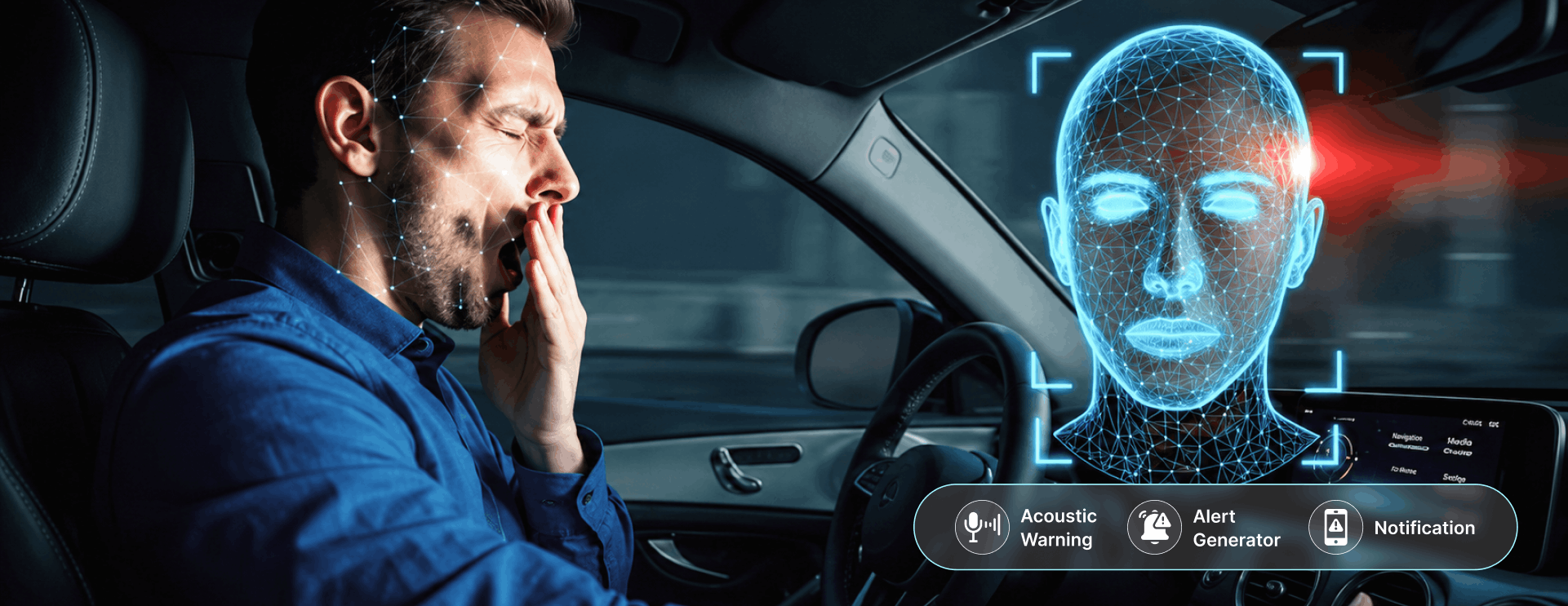
This case study outlines the development, deployment, and real-world impact of an Intelligent Driver Behavior Analytics (DBA) platform. Unlike systems designed for autonomous vehicles, this technology is built entirely from a driver-centric perspective. It serves as an active, intelligent guardian for human drivers in conventional, commercial, and connected fleets. By fusing edge-computed 3D Machine Vision, Acoustic NLP, and Kinematic Telematics, this platform serves as a proactive cabin safety shield that monitors driver fatigue, distress, and distraction in real time.
The system actively mitigates behavioral risks and micro-sleeps to maintain continuous operational awareness, while instantly triggering life-saving emergency protocols and telemetry broadcasts the moment an unavoidable high- impact occurs.
Problem Statement: The Global and Indian Road Safety Crisis
Behavioral Anomalies is the leading variable in vehicular accidents worldwide. Fatigue, cognitive distraction (mobile phone usage), emotional distress, and sudden medical emergencies turn vehicles into unguided projectiles. When a driver falls asleep or loses focus, a window of just two seconds determines the boundary between a near-miss and a fatal impact.
Global Statistical Context
On a global scale, road traffic accidents present an epidemic-level challenge to public health
and fleet logistics:
- Total Fatalities: According to the World Health Organization (WHO), approximately 1.19 million people die each year as a result of road traffic crashes.
- The Human Element: Research indicates that 94% of all traffic accidents are directly attributable to Behavioral Anomalies, with driver distraction or drowsiness accounting for 25% to 30% of commercial vehicle mishaps.
- Economic Cost: Road crashes cost most countries 3% of their gross domestic product (GDP) due to lost productivity, medical liabilities, and material damage.
Indian Statistical Context
India presents one of the most hostile and high-risk driving environments in the world. The challenges are amplified by long shifts for commercial operators, high traffic density, and mixed vehicle types on roads:
- The Disproportionate Toll: India accounts for roughly 11% of all global road crash deaths, despite possessing less than 2% of the world`s total vehicle population.
- Annual Mortality: Data from the Ministry of Road Transport and Highways (MoRTH) shows that over 168,000 individuals lose their lives on Indian roads annually-averaging roughly 460 deaths per day or one death every 3 minutes.
- The Commercial Driver Crisis: Long-haul truck and bus drivers routinely operate for 14 to 16 hours continuously without mandated rest breaks. Studies show that 40% of truck drivers on golden quadrilateral highways suffer from chronic sleep deprivation, making micro-sleeps an imminent, daily threat.
- Distraction Metrics: Over 70% of Indian drivers admit to using their mobile phones while actively navigating traffic, vastly increasing cognitive distraction.
Key Takeaways
- 3D Facial Mesh Tracking: Maps 68 landmarks locally for real-time stress and expression analysis.
- Ocular Fatigue Diagnostics: Calculates EAR and PERCLOS to identify immediate micro-sleep events.
- Offline Acoustic NLP: Detects vocal panic spikes, screams, and localized multilingual distress keywords.
- Kinematic Impact Telematics: Uses a 3-axis accelerometer and high-g shock sensors for crash detection.
- Zero-Cloud Privacy Engineering: Restricts processing to volatile RAM with immediate raw data destruction.
Why Choose Dotcom IoT for Behavior analytics?
- Microsoft-Awarded Innovation: Globally recognized engineering team specializing in advanced, end-to-end IoT system architecture and integration.
- Prototype-to-Production Pipeline: Seamlessly delivers custom automotive-grade PCB design, edge firmware, and hardware optimization entirely under one roof.
- Edge-Native AI Domain Expertise: Deeply experienced in deploying high-performance local machine vision and offline NLP without cloud dependencies.
- Ruggedized Field Architecture: Proven track record of engineering robust embedded hardware built specifically for high-vibration and high-dust environments.
- Privacy- First Engineering Frameworks: Implements strict data protection standards, ensuring secure mathematical coordinate extraction and zero telemetry leaks.
Development Challenge
- Hardware Vulnerability to Cabin Dust: Preventing heavy dirt and dust accumulation on the infrared camera lens from degrading 3D facial mesh accuracy.
- Chassis Vibration Sensor Noise: Filtering out persistent high-frequency road bumps and potholes from actual erratic driving or crash telemetry.
- Edge Compute Thermal Limits: Managing concurrent vision, NLP, and fusion pipelines on the Jetson Orin Nano without triggering thermal throttling in hot cabin environments.
- Pruned Offline Multilingual NLP: Compressing speech recognition models to fit limited edge memory while maintaining high accuracy for diverse regional dialects.
- Strict Zero-Cloud Privacy Routing: Engineering a secure, volatile RAM-only data pipeline that reliably destroys raw video and audio frames within 15 milliseconds.
The Proposed Solution: A Driver-Centric Cognitive Guardian

- By maintaining processing directly on edge hardware inside the vehicle, the system protects driver privacy while operating with an ultra-low latency of under 15 milliseconds. This speed is critical for triggering in-cabin interventions that can snap a drowsy driver back to attention.
Technical Module Breakdown from the Drivers Perspective
1. 3 D Machine Vision & Facial Expression Analysis
The vision module uses a cabin-mounted Ne; ar-Infrared (NIR) camera positioned on the steering column or A-pillar. This camera remains functional during night driving, tunnel transits, and varying light conditions, even if the driver wears sunglasses. Instead of basic 2D imaging, the engine maps a dense 3D Facial Mesh comprising 68 node points. The system tracks structural shifts using the Facial Action Coding System (FACS) to identify driver stress:
- Acute Stress & Panic: The system monitors Action Unit 1 (Inner Brow Raiser) and Action Unit 4 (Brow Lowerer). Sudden compression of these regions indicates high frustration, physical pain, or an impending panic response.
- Shock/Surprise: Action Unit 20 (Lip Stretcher) tracks horizontal mouth elongation, a reliable facial indicator of sudden fright or shock.

2. Ocular Analytics: Eye Closures & Micro-Sleep Mitigation
To counter the threat of driver fatigue, the platform prioritizes real-time eye monitoring. It computes the Eye Aspect Ratio [(EAR) by analyzing six key landmarks surrounding the eye structure (p_1 top_6)].

The system evaluates the EAR signal against two primary operational states:
- Standard Blinks: A sharp, rapid drop in EAR that recovers within 100 to 250 milliseconds.
- Fatigue & Micro-Sleep Events: The EAR drops below a critical threshold ( au_{EAR} approx 0.2) and remains suppressed for longer than 500 milliseconds.
If a prolonged drop occurs, the system logs a Micro-Sleep Event. Coupled with Percentage of Eye Closure (PERCLOS) calculations over a 1-minute window, this metric allows the system to intervene before a driver drifts out of their lane.
3. Kinematics & Chassis Interaction: Accelerometer and Shock Sensors
The system tracks the physical behavior of the vehicle relative to the driver`s inputs via an Inertial Measurement Unit (IMU) and a secondary piezoelectric shock sensor.
- 3-Axis Accelerometer: This sensor monitors longitudinal (a_x), lateral (a_y), and vertical (a_z) forces at 200 Hz. It detects aggressive driving profiles such as sudden hard braking, erratic swerving, and rapid lane changes.
- Piezoelectric Shock Sensor: While the IMU tracks vehicle handling, the shock sensor acts as an instant mechanical interrupt. Calibrated for extreme forces (>5 ext{g}), it triggers only during structural impacts. If a collision occurs, this sensor overrides all standard CPU tasks to prioritize safety protocols within microseconds.
4. Acoustic Intelligence & In-Cabin Voice NLP
Sound monitoring provides crucial context when visual lines of sight are temporarily broken. Using a dual-microphone array with active noise cancellation, the cabin`s audio environment is split into distinct acoustic signatures.
- Acoustic Event Detection (AED): A lightweight convolutional network monitors incoming audio streams for specific anomalies: sharp gasps, sudden screaming, structural glass shattering, or metal deformation.
- Voice NLP & Keyword Spotting: An offline, on-device Natural Language Processing engine listens for high-priority emergency keywords. In India`s multilingual environment, this model is trained to recognize regional distress phrases (e.g., "Help , "Bachao , "Roko ).
When a driver shouts, the system checks the fundamental vocal frequency (F_0) and audio amplitude. A significant spike indicates high distress, causing the system to raise its internal alert level. Multi-Sensor Fusion Framework
Relying on a single sensor can lead to false alarms. For example, a driver might yawn without being exhausted, or a rough patch of road could look like aggressive weaving on an accelerometer. To prevent this, the platform passes all data streams through a centralized fusion layer.
Driver-Centric Threat Matrix

Driver-Centric Remediation & Post-Accident Rescue Protocols
When the system identifies an operational threat, it acts directly to assist the human driver through a series of progressive interventions.
In-Cabin Active Remediation
- Phase 1: Sensory Awakening (Fatigue Countermeasures): When the system detects progressive drowsiness, it uses targeted audio frequencies and haptic pulses through the steering wheel or seat base to wake the driver.
- Phase 2: Distraction Alerts: If a driver looks down at a mobile phone while the vehicle is moving, the system delivers a targeted audio alert from that specific direction, prompting them to look back at the road.
- Phase 3: Pre-Impact Preparation: If an imminent crash is identified through a combination of a driver s panic shout, sudden swerving, and a look of shock, the system optimizes cabin safety. It commands the seatbelt pretensioners to pull tight, anchoring the driver securely to maximize the effectiveness of the vehicle s airbags.
Post-Accident Rescue Blueprint
If an impact occurs and the shock sensor threshold is crossed, the system immediately switches to an emergency response mode focused on saving lives:
POST-IMPACT PROTOCOL LIFELINE

- The Critical Golden Hour: In emergency medicine, the "Golden Hour" is the first 60 minutes after a traumatic injury. Fast medical treatment during this window drastically increases the chances of survival.
By automatically broadcasting accurate location and occupancy data within 3 seconds of a crash, the system eliminates reliance on the driver or passing witnesses to call for help, which can save vital minutes on remote highways.
Future Scope:
- Sensor Layer Ruggedization: Designing physical protection against high cabin dust and rough-road vibrations.
- Active Vehicle Control Integration: Connecting with the ECU to safely pull over vehicles during medical emergencies.
- Dialect Expansion for Edge NLP: Training the local voice engine to recognize more regional transport sub-dialects.
- Satellite Telemetry Fail-Safes: Implementing low-Earth-orbit satellite tracking for remote areas lacking cellular networks.
- Predictive Driver Wellness Profiling: Analyzing long-term stress patterns to recommend mandatory rest breaks before fatigue sets in.
“Privacy-first cognitive guardian mastering driver behavior - turning distraction into focus, fatigue into awareness, and critical seconds into saved lives.”


