Executive Summary
Dotcom IoT designed and deployed a smart IoT-enabled Dosing and monitoring system that continuously monitors critical parameters such as pH, electrical conductivity (EC), temperature, and nutrient levels.
The solution enables real-time data access, remote management, and automated control, helping the farm achieve higher productivity with reduced operational effort.
The Challenge: Operational Hurdles in Hydroponic Farming
The hydroponic farm relied on conventional control methods and manual supervision to manage nutrient dosing and water quality. This approach resulted in inconsistent crop growth, higher resource consumption, and limited visibility into real-time system performance.
Key challenges included:
- Difficulty in maintaining accurate pH and EC levels across different growth cycles
- Lack of real-time monitoring of nutrient concentration and water temperature
- High dependency on manual intervention for dosing and irrigation control
- Limited scalability due to complex wiring and bulky control infrastructure
- Inefficient data logging, making it hard to analyze trends and optimize operations
These challenges made it difficult for the farm to achieve uniform crop quality and operational efficiency while expanding their hydroponic setup.
Development Challenges:
Along with operational challenges, the system development involved several technical and implementation-level complexities:
- Precise multi-GPIO scheduling: Managing and triggering 24 GPIO outputs simultaneously with accurate time-based scheduling for pumps, lights, and auxiliary devices required careful task synchronization and timing control.
- Multi-task communication handling: Managing and triggering 24 GPIO outputs simultaneously with accurate time-based scheduling for pumps, lights, and auxiliary devices required careful task synchronization and timing control.
- Over-the-air (OTA) firmware updates via LoRaWAN: Implementing secure and reliable OTA update functionality over a low-bandwidth LoRaWAN network posed challenges in packet management, fault tolerance, and version control.
- Dosing control based on different operating modes: Managing control logic to manage nutrient dosing under multiple operating modes while maintaining stable system behavior and accuracy.
- LCD-based user interface for multiple configurations: Developing an LCD-based user interface to support and manage different system configurations and operational states, while ensuring clear visual indication and ease of on-site interaction.
The Solution: Smart Hydroponic Monitoring & Control
A client required a reliable system to continuously monitor and regulate nutrient dosing, water quality, and environmental conditions in order to achieve uniform crop growth and reduce dependency on manual supervision.
The existing setup lacked real-time visibility and precise control, making it difficult to maintain stable pH, EC, and temperature levels across different growth stages.
To meet these operational requirements, Dotcom IoT developed and deployed a customized IoT-based hydroponic monitoring, control, and alerting solution at the client’s hydroponic facility.
The solution integrates smart sensor nodes and a centralized controller to continuously measure pH, electrical conductivity (EC), temperature, and nutrient concentration. These values are processed instantly to trigger automated dosing and irrigation actions, ensuring optimal growing conditions at all times.
Key elements of the solution include:
- Smart sensor units for real-time monitoring of water quality and environmental conditions
- Threshold-based alert mechanism for pH, EC, and temperature deviations
- Wireless communication for seamless data transmission to a central platform
- Modular architecture allowing easy expansion as farming operations grow
Key Takeaways
- Real-time monitoring of EC, pH, and temperature enables precise nutrient control.
- Microcontroller with 24 GPIO ensures reliable multi-pump operation.
- LoRaWAN connectivity allows long-range, low-power remote monitoring.
- Automated dosing reduces manual effort and operational errors.
- On-device LCD provides instant local system visibility.
- Modular design supports future expansion and advanced analytics.
Why Choose for Hydroponic Farming Solutions?
- Proven expertise in designing custom IoT hardware and firmware for agriculture applications
- End-to-end capability covering sensing, control, communication, and cloud integration
- Strong experience in building closed-loop automation systems for EC, pH, and temperature control
- Scalable architecture using long-range wireless communication for multi-zone deployments
- Focus on reliability and field-ready design for continuous farm operations
- Flexible and modular solution tailored to different farm sizes and crop requirements
System Architecture & Technology Layers
The hydroponic automation solution is engineered using a multi-layer IoT architecture that tightly integrates sensing, control, communication, and software intelligence. The system is deployed directly at the cultivation site to enable real-time nutrient management and continuous monitoring of water quality parameters without human dependency.
The architecture is designed to operate reliably in field conditions while supporting remote visibility and scalable expansion.

Hardware Layer
The hardware layer acts as the central intelligence of the system and is responsible for data acquisition, processing, and actuation control.
It is built around:
- A Low Power microcontroller unit (MCU) designed for industrial control applications
- A total of 24 General Purpose Input/Output (GPIO) pins are used for direct control of dosing pumps and irrigation peripherals, enabling time-based scheduling and automated nutrient delivery cycles for crop growth.
- These GPIO-controlled devices include fogging pumps, air circulation and exhaust fans, RO pumps, LED grow lights, external alarms, and irrigation pumps.
- Analog signal conditioning circuits for interfacing EC, pH, and temperature sensors.
- Digital control circuits for precise ON/OFF and timed activation dosing pumps.
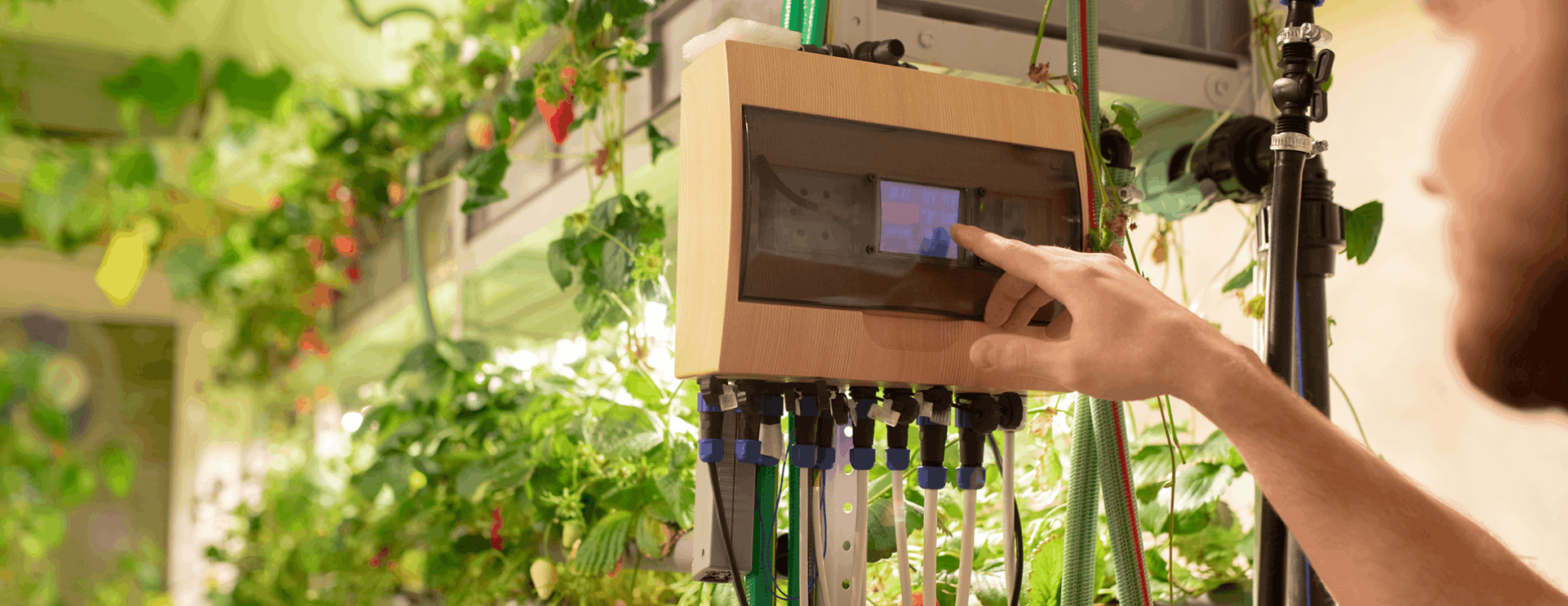
- An integrated LCD display for on-site visualization of live parameters and system status allows users to configure device settings.
- An integrated LCD interface enables on-site configuration and scheduling of connected GPIO peripherals such as irrigation pumps, Fogging Pump, Solenoid valve and Air Circulation Fan.
- Power regulation and protection circuitry supporting DC 24V operation.
- The system retains the last saved configuration even during power failure.
Device Layer
This layer consists of:
- An Electrical Conductivity (EC) sensor for measuring dissolved nutrient concentration in the water
- A pH sensor for monitoring acidity and alkalinity of the nutrient solution
- A temperature sensor for tracking the thermal condition of the solution
- Six electrically controlled dosing pumps responsible for injecting nutrient solutions and EC & pH correction liquids
Communication Layer
This layer uses:
- IoT Controllers installed at the hydroponic site collect sensor data and interact with dosing/irrigation devices.
- Data is sent to an IoT Gateway.
- The gateway forwards data to the LoRaWAN Network Server via LAN, Wi-Fi, or Cellular connectivity for aggregation and secure transmission.
- Sensor readings, system alerts, and configuration commands are accessible on both web and mobile applications, enabling remote monitoring, notifications, and management.
- This wireless setup reduces cabling complexity while supporting multi-controller scalability across large farm setups.

Software Layer
The software layer is responsible for data acquisition, transmission, visualization and configuration of system parameters.
It consists of:
- Embedded firmware running on the MCU for real-time sensor data collection
- Communication software for transmitting data over LoRaWAN
- Integration with an existing cloud platform for data storage and visualization configuration
- Continuous real-time display of EC, pH, and temperature values
- Threshold-based alert generation when parameters exceed defined limits
- Audible alarm (buzzer) activation on the device for immediate field alerts
- Time-based scheduling of irrigation and peripheral devices using GPIO control logic for automated crop growth cycles
- Remote notification alerts sent to the user’s mobile device for instant awareness
Future Scope:
- AI-driven nutrient optimization: By applying machine learning algorithms on historical EC, pH, and temperature data, the system can automatically optimize nutrient recipes for different crop types and growth stages.
- Advanced sensor integration: Additional sensors such as dissolved oxygen, water level, and flow rate can be integrated to provide deeper insight into system health and nutrient circulation efficiency.
- Predictive maintenance: Data analytics can be used to predict pump failures, sensor drift, or abnormal operating conditions, enabling proactive maintenance and minimizing downtime.
- Multi-zone automation: The architecture can be extended to control multiple hydroponic zones independently, allowing farmers to manage different crops or growth cycles within the same facility.
- Mobile application integration: A dedicated mobile app can provide real-time alerts, parameter visualization, and remote control, improving accessibility for farm operators.
- Cloud-based farm intelligence: Aggregated data from multiple installations can be used to build centralized farm intelligence platforms, supporting benchmarking, performance comparison, and decision support systems.


