Executive Summary
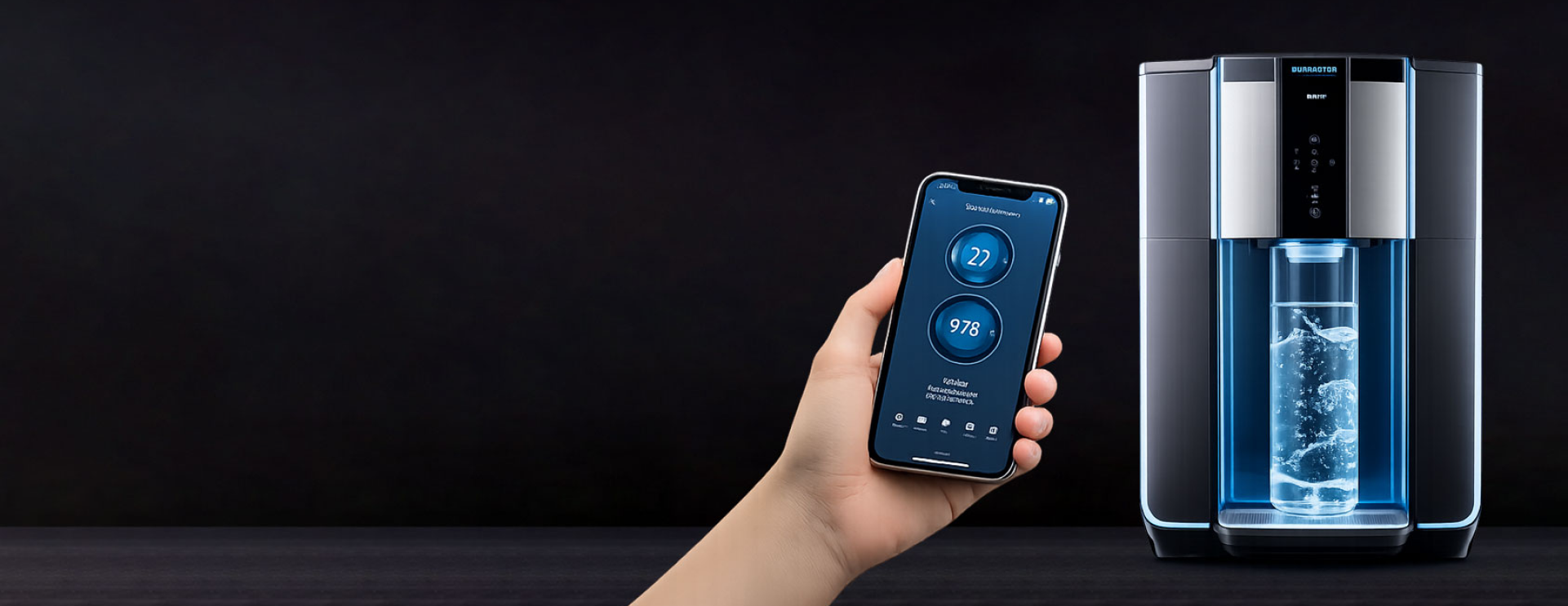
A Smart Water Purifier platform developed by Dotcom IoT adds automation, intelligence, and transparency to traditional water purification systems.
In order to provide safe drinking water while maximizing filter utilization, cutting down on water waste, and streamlining service operations, the solution integrates real-time water quality monitoring, adaptive filtration logic, cloud connectivity, and mobile applications.
The system automatically switches between UV and RO+UV purification modes based on water quality while continuously monitoring inlet and outlet TDS, water consumption, and filter health. The purifier can be remotely monitored, controlled, and maintained by users, service engineers, and administrators thanks to a connected mobile app and cloud-based admin platform.
The Challenge: Operational & User Experience Gaps
There are several operational and user-experience issues with traditional water purifiers:
- No centralized system to manage devices, services, and firmware updates at scale
- No real-time visibility into actual water quality (TDS)
- Static filtration logic that results in needless RO usage and water waste
- Filter replacement based on time rather than actual usage or performance
- Manual service dependency and delayed maintenance
- Lack of consumption analytics for users
The Solution: “Our Intelligent IoT-Based Solution”
Dotcom IoT developed an end-to-end Smart Water Purifier system where in a normal water purification system is converted to a smart one.
It combines technologies like water quality sensors, adaptive purification controllers, cloud services, and mobile apps to provide clean drinking water while minimizing filter usage and water waste.
At the heart of the solution is a Wi-Fi enabled embedded controller, which monitors the TDS of inlet and outgoing water, water flow rates, pressure, and tank levels. Based on the live values of TDS, which can be adjusted to predefined limits, the purifier automatically selects between UV and RO + UV mode of operation.
This platform is complemented by:
- User mobile application to facilitate real-time monitoring and service requests.
- A service engineer application for efficient field operations.
- A cloud-based administration panel to manage devices, analytics, as well as OTA updates.
This combined system is also possible with predictive maintenance and deployment possibilities, thus supporting its suitability for use in both home and commercial installations for water purifiers.
How It Works?
The process of purification is automated and data-driven in the case of the Smart Water Purifier:
- Inlet TDS Measurement: The inlet sensors measure the continuous incoming water quality.
- Adaptive Filtration Logic: Based on real time TDS values, the system will automatically select. > UV mode for low TDS water > RO + UV mode for high TDS water
- Flow & Consumption tracking: It provides real-time and total consumption of water through a flow sensor for accurate usage analytics.
- Filter Health Evaluation: Assessment of filter performance will be done by rating the data on usage and variation of inlet–outlet TDS for predictive maintenance alerts.
- Cloud Sync & User Alerts: Sync of operational data to the cloud, with real-time status and notifications provided through the mobile app.
- Remote Configuration & OTA Updates: System settings and firmware updates are managed over the air to guarantee reliability and scalability for the long term.
Key Takeaways
- The Smart Water Purifier project demonstrates how a traditional appliance can be transformed into a connected, intelligent, and data-driven system.
- By combining real-time sensing, adaptive purification logic, cloud connectivity, and mobile applications, the solution improves water quality transparency, reduces wastage, and enables predictive maintenance.
- This case study highlights Dotcom IoT’s capability to build scalable and future-ready IoT products from hardware to cloud.
Why Choose Dotcom IoT ?
- End-to-End IoT Expertise: Hardware design, firmware development, cloud backend, and mobile/web applications under one roof.
- Scalable & Secure Architectures: Proven experience in building connected systems with OTA and cloud integration.
- Customization-Focused Approach: Solutions tailored to specific product and business requirements.
- Real-World Deployment Experience: Strong understanding of field challenges, service workflows, and lifecycle management.
- Future-Ready Design Philosophy: Architectures built for long-term upgrades and feature expansion.
Technical Architecture of the Smart Water Purifier:
The Smart Water Purifier is designed using a layered IoT architecture that seamlessly connects the physical purification system with cloud intelligence and user-facing applications. This architecture ensures reliable sensing, adaptive control, secure data communication, and salable system management.

Device and Sensing layer:
- The system is designed with ESP32-S3 microcontroller which is used as the central processing unit of the purifier.
- A set of sensors constantly measures the real time operating data, such as the inlet and outlet TDS value, the rate of water flowing in the tank and the level of water in the tank and the inlet pressure conditions.
- These inputs enable the system to know the purifier`s health and the water quality.
- Miscellaneous actuation devices like solenoid valves and the UV lamp can be driven by relay interfaces which allows the stages of water routing and purification to be dynamically controlled according to system logic.
Control and Processing layer:
- The control and processing layer is applied as embedded firmware executed on the microcontroller.
- This layer works with sensor data and implements the adaptive purification algorithm. > Following real time TDS measurements, the controller dynamically switches between UV purification and RO+UV purification to achieve optimum treatment without wasting water without any need. > The flow sensor data is continuously used to calculate water consumption, the health of the filter is estimated by using the volume of use and the inlet-outlet TDS change.
- Safety mechanisms include blockage detection, tank-level control, and dry-run prevention which are also controlled by the firmware.
- The system has secure OTA firmware updates to ensure long-term maintainability and remote-modifiable configurable parameters.
Cloud layer and connectivity:
- It allows the purifier to connect with the backend platform via MQTT via Wi-Fi.
- All important operating information - such as TDS level, usage history, the condition of the filter, and the health of a device - is safely transferred to the cloud service consisting of AWS.
- The cloud layer deals with processing of real-time data, storage of past data and generation of alerts.
- It also keeps the identity of the devices, firmware versions and configuration in sync, so that every unit deployed stays connected and controllable throughout its lifecycle.

Web Layer:
- Provides centralized management and continuous monitoring of all connected purifier units across different locations.
- Displays historical and real-time trends of inlet and outlet TDS, water consumption, and filter health through visual dashboards.
- Supports remote firmware control, configuration management, and real-time alert tracking for proactive system maintenance.
- Enables secure, role-based access for administrators and service teams to manage devices and service operations efficiently.
Application & Use Cases:
- Household Water Quality Monitoring: Allows maintaining a constant level of TDS inlet and outlet to maintain potable water at home.
- Filter Usage based filter management: The filter management allows the replacement of filters in response to actual usage and performance rather than on time interval.
- Remote Service & Maintenance: Allows service teams to remotely diagnose problems and plan maintenance pro-actively to eliminate downtime
- Smart Water Consumption Tracking: Assists users to track their water consumption on a daily and monthly basis and encourages them to use water efficiently.
- Scalable Deployment Management: Enables centralized monitoring and control of various purifier units of residential complexes and commercial set-ups.
Security & Compliance:
- Secure device-to-cloud communication using encrypted MQTT channels.
- Device authentication to ensure only authorized purifiers connect to the platform.
- Role-based access control for users, service engineers, and administrators
- Firmware & OTA security using validated and controlled update mechanisms.
- Data handling aligned with standard IoT security and privacy practices.
Future Scope:
- AI-Based Water Quality Prediction: Use historical TDS and usage data to predict water quality trends and optimize purification logic automatically.
- Subscription-Based Filter Management: Enable automated filter replacement cycles with subscription and billing integration.
- Community & Building-Level Monitoring: Extend the platform to manage multiple purifiers in apartments, offices, and commercial buildings from a single dashboard.
- Advanced Analytics for Water Conservation: Provide insights into consumption patterns to promote efficient water usage and sustainability.
“Turning Everyday Water into Smarter, Safer Drinking with an IoT-Based Smart Water Purification System.”


