Executive Summary
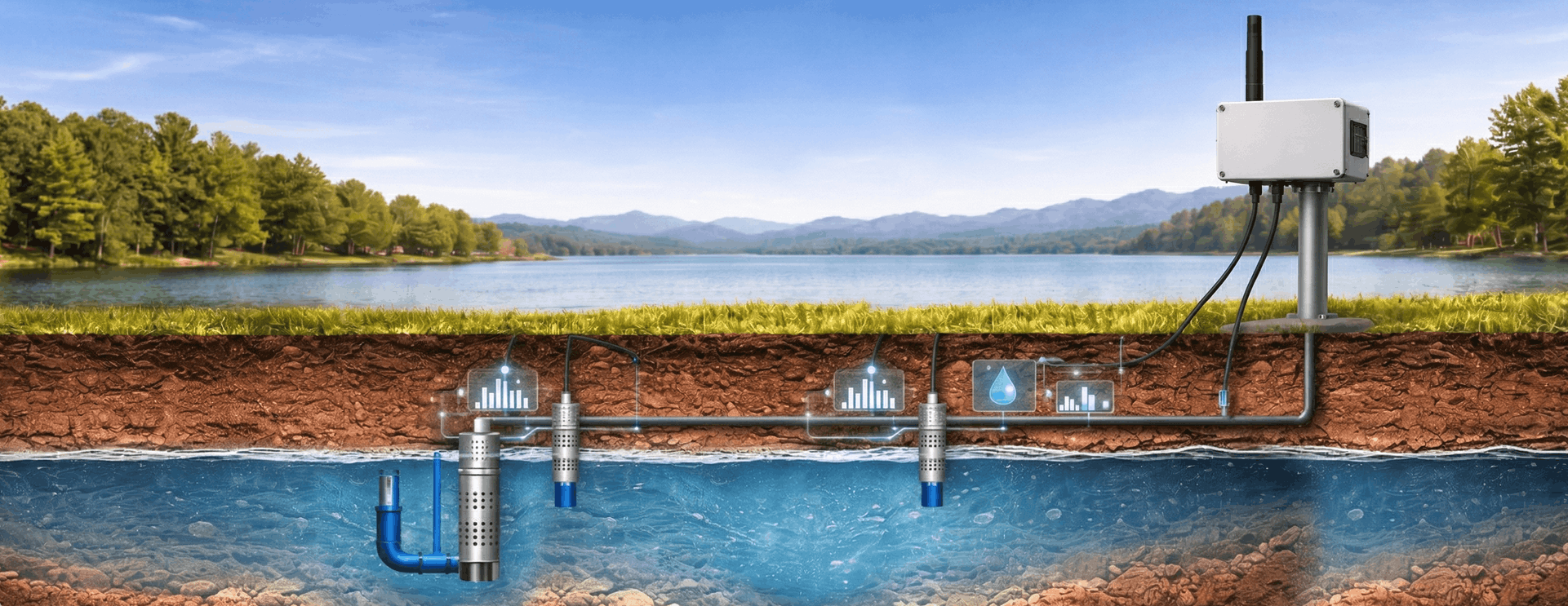
This case study presents an IoT-based remote groundwater monitoring system developed for leading French company. The solution enables automated collection of key groundwater parameters from remote field locations and transmits the data using both satellite and cellular communication networks.
The system eliminates the need for manual data collection and ensures reliable data delivery from infrastructure-less regions. Continuous monitoring is achieved through integration with a cloud-based platform for storage and analysis.
The embedded firmware was designed to support ultra-low power operation, compatibility with multiple industrial probes, and long-term unattended field deployment in harsh outdoor environments.
Client Overview:
The client have a technology-driven company, focused on developing advanced monitoring solutions for environmental and groundwater applications. Their products are deployed in geographically remote locations where conventional communication networks are unavailable or unreliable.
They required a smart, autonomous monitoring node capable of:
- Interfacing with industrial groundwater probes
- Operating on battery and solar power for long-term deployment
- Communicating using satellite technology in remote areas
- Delivering data securely to cloud-based and government servers for analysis and reporting
Their objective was to build a reliable and scalable monitoring solution suitable for long-term groundwater observation projects.
The Challenge: Power, Probe Integration, and Long-Range Data Transmission
The project faced multiple technical and operational challenges:
- Absence of cellular network coverage in remote deployment locations
- Dependence on manual field visits for data collection
- Requirement for extended battery life and low-power operation
- Integration of multiple industrial groundwater probes using a common interface
- Ensuring reliable long-distance data transmission from field locations
- Data transmission to both cloud and FTP servers
- Operation in harsh outdoor environments
Development & Integration Challenges:
Along with field-related challenges, the project also involved several technical difficulties during firmware and communication development:
- Incomplete probe information: > One of the groundwater probes did not have a complete datasheet or communication reference available. > Due to this, the exact data format and register details were not initially known. > The firmware team had to analyze raw data responses through repeated testing in order to correctly decode and map the sensor values.
- Satellite communication registration issue: > During satellite integration, a registration-related issue was observed in the satellite communication module. > Because of this issue, data transmission was not happening reliably in the initial phase. > The firmware logic was updated to handle this behavior and ensure successful data transfer to the satellite network.
- Uncertainty of satellite visibility (blind spots): > At the start of development, the exact satellite availability timing was not clearly defined. > To overcome this, the device had to send data multiple times to ensure at least one successful transmission window. > This required careful optimization to maintain reliability while controlling power consumption.
- Data format and protocol stability: > Ensuring that sensor data, timestamps, and device identifiers were correctly packaged for both satellite and cellular communication required multiple test cycles and validation steps.
The Solution: IoT-Based Remote Groundwater Monitoring with Dual Connectivity
To address the client’s requirements, Dotcom IoT developed the complete embedded firmware and communication logic for the groundwater monitoring device provided by Client. The hardware platform and industrial probes were supplied by the client, while our scope focused on enabling reliable sensor communication, data processing, and long-distance data transmission.
The device was designed to work with multiple industrial groundwater probes through a common RS485 interface. Although multiple probes can be connected to the system, only one probe is selected and activated at a time based on the deployment requirement.
Key Takeaways
- A fully automated groundwater monitoring system was successfully implemented for client using industrial probes and long-range communication technologies.
- The solution enables continuous data collection from remote locations without dependence on manual field visits.
- Dual communication support (satellite and cellular) ensures reliable data delivery from both network and non-network regions.
- Embedded firmware was optimized for low power consumption, enabling long-term unattended deployment using battery and solar power.
- GNSS-based location tagging allows accurate mapping of groundwater data to specific monitoring sites.
- The system provides a scalable and reliable foundation for long-term groundwater observation and reporting.
Why Choose Dotcom IoT ?
- Proven capability in developing robust embedded firmware for industrial and environmental monitoring applications
- Experience in integrating multiple industrial probes using standardized communication interfaces such as RS485
- Strong expertise in satellite and cellular communication protocols for remote data transmission
- Focus on ultra-low power design for battery and solar-operated field devices
- Ability to deliver reliable, production-ready firmware for harsh outdoor environments
- Flexible and client-focused development approach tailored to project-specific requirements
Supported Probes:
The firmware was developed to support the following groundwater probes:
1. NKE Sensor – Probe
- The NKE groundwater probe is designed for long-term monitoring of water level and temperature in wells and boreholes.
- For this probe, Dotcom IoT developed the complete embedded firmware responsible for sensor operation and data communication.

- Acquisition of raw pressure and temperature signals from the sensing elements
- Applying calibration and compensation algorithms to raw sensor values
- Deriving water level information from pressure measurements
- Managing probe-specific command and response sequences over RS485
- Structuring measurement data into standardized output frames
- Reliable transmission of measurement data to the monitoring device
2. Aquatroll Sensor - Probe
- The Aquatroll sensor is a multiparameter groundwater probe used for hydrological and environmental monitoring applications. It is capable of measuring water level (pressure), temperature, and electrical conductivity.
- For this probe, Dotcom IoT developed the embedded firmware to handle complete sensor operation and data processing.

The Aquatroll probe firmware includes:
- Parallel acquisition of pressure, temperature, and conductivity signals
- Independent processing and calibration of each sensing parameter
- Synchronization of multiparameter readings into a single measurement set
- Management of compound data structures containing multiple sensor values
- RS485-based communication handling for multiparameter payloads
- Formatting of combined sensor data into unified transmission packets
- Transmission of processed data to the monitoring device
This firmware enables the Aquatroll probe to function as a multi-sensor measurement unit capable of delivering reliable and synchronized groundwater data for long-term monitoring projects.
3. Seba Sensor - Probe
- The Seba probe is designed for high-accuracy groundwater monitoring in remote and harsh field environments.
- It primarily measures water level (pressure) and temperature and is optimized for long-term unattended operation.
- Dotcom IoT developed the embedded firmware for the Seba probe to support accurate sensing and reliable communication with the monitoring device.

The Seba probe firmware performs the following tasks:
- Continuous acquisition of pressure and temperature sensor data
- Conversion of raw sensor signals into calibrated digital values
- Filtering and validation of measurement data
- Implementation of Seba probe communication protocol over RS485
- Creation of structured response frames containing sensor readings and probe status
- Stable and reliable data transmission to the monitoring device
Low-Power Operation & Reliability:
- The firmware automatically manages data transmission using either communication path, ensuring that monitoring data reaches the server regardless of network availability.
- Low-power operation was a key design objective
- The firmware was optimized using sleep and wake-up cycles to support long-term operation on battery and solar power.
- Additional mechanisms such as communication retries and error handling were implemented to improve system reliability and reduce the risk of data loss.
- This approach enabled automated and continuous groundwater monitoring with minimal human intervention, making the system suitable for long-term deployment in remote and challenging environments.
Communication Architecture (Cellular + Satellite):
The groundwater monitoring system is designed with a dual communication architecture to ensure reliable data transmission from remote field locations.
Depending on network availability, the system transmits collected groundwater data using either cellular communication over HTTPS or satellite-based communication.
For this project, Dotcom IoT developed the probe-level firmware and the data communication logic that enables seamless transmission through both cellular and satellite networks.
The architecture ensures uninterrupted data flow from groundwater probes to backend servers, even in geographically isolated and infrastructure-less regions.
Cellular Communication Path:
When cellular network coverage is available, the monitoring device transmits collected groundwater data using secure HTTPS communication

Operational sequence:
- The selected groundwater probe measures parameters such as water level, temperature, and electrical conductivity.
- Sensor data is collected by the device firmware through the RS485 interface.
- The firmware packages the data into structured payloads suitable for HTTPS transmission.
- The cellular modem connects to the nearest cellular tower and establishes an internet connection.
- Data is securely transmitted to the cloud server using HTTPS protocol.
- The server stores the data and makes it available for visualization, analytics, and external system integration via APIs and FTP services.
We implemented the logic to package probe data into HTTPS-compatible frames and manage reliable transmission over cellular networks.
Reliability and Power Optimization:
- Automatic reconnection in case of network loss
- Retry mechanism for failed transmissions
- Data buffering during temporary connectivity failures
- Low-power sleep modes between transmission cycles
Satellite Communication with GNSS Integration:
For remote deployment locations where cellular connectivity is unavailable, the groundwater monitoring system uses satellite-based communication combined with GNSS positioning to ensure reliable data delivery and accurate geolocation of measurement points.
The satellite-enabled device provided by client is equipped with an integrated satellite modem and GNSS receiver. Dotcom IoT developed the embedded firmware responsible for probe data acquisition, GNSS data handling, and satellite communication using the Kineis communication protocol. The firmware formats sensor data into compact payloads that comply with the Kineis protocol requirements and manages reliable uplink transmission over the satellite network.
Operational sequence:
- The groundwater probe (NKE, Aquatroll, or Seba) measures parameters such as water level, temperature, and conductivity.
- Probe data is collected by the monitoring device through the RS485 interface.
- The firmware processes and formats the sensor readings into compact satellite-compatible data frames.
- The satellite modem transmits these data packets to the low-earth-orbit satellite constellation operated by Kineis protocol.
- The satellites relay the data to the nearest ground station.
- From the ground station, the data is delivered to the Kineis Web Platform, where incoming messages are decoded, validated, and stored.
- The processed data is then forwarded from the Kineis Web Platform to the client’s central data center and cloud servers through secure APIs or data interfaces.

GNSS (Location Tracking) Integration
In addition to probe measurements, the system also captures GNSS-based location data to associate each groundwater reading with its precise geographic position.
The GNSS module embedded inside the device provides:
- Latitude and longitude coordinates
- Time synchronization using satellite time reference
- Validation of device deployment location
- The firmware schedules transmissions based on configured intervals
- Retry mechanisms handle temporary satellite unavailability
- Acknowledgment handling ensures confirmed delivery
- Low-power sleep cycles are applied between transmissions
- Transmission is attempted only when valid GNSS fix and sensor data are available
Future Scope:
- Integration of additional water quality sensors (pH, turbidity, dissolved oxygen, nitrates)
- Support for advanced analytics and AI-based groundwater trend prediction
- Real-time alert generation for abnormal water level or quality conditions
- Expansion to large-scale monitoring networks with hundreds of distributed nodes
- Enhanced remote device management including over-the-air (OTA) firmware updates
- Adoption of advanced power optimization techniques for ultra-long field deployments


